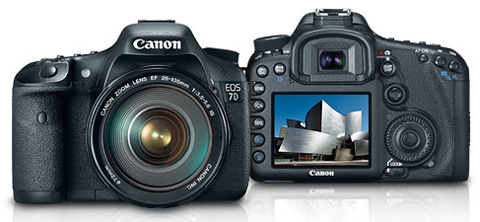
Canon EOS 7D
Shortly after the announcement of the EOS 7D camera by Canon, I wrote a post here on my blog where I mentioned that the 7D looked like a very promising camera. Before I continue with my review of the 7D, let me take a moment to discuss some of the things I said in that previous post.
I mentioned right from the start that the noise in 7D images was a concern for me, this is what I wrote:
The only thing that I’m not so sure about right now is the image quality. Canon has included a new 18MP sensor in the 7D which, from the sample images I have seen so far, appears to deliver much better image quality compared to the EOS 50D even while having a higher pixel count, and comes close to the EOS 5D Mark II. I could see no pattern noise and banding issues so far, like I mentioned before, and this is a very good thing. However, looking at RAW files, I still think that the images produced by the 7D contain a little too much noise, even at lower ISO values, and the images at high ISO contain way too much noise. JPEG images coming out of the camera look better because of the noise reduction being done inside the camera, at the expense of lost detail, but RAW images look terrible so far.
As you will soon see, this is exactly the case. Another thing I mentioned was the following:
Looking at Canon’s recent DSLR releases and all the quality control issues they’ve had, it would be wise to wait at least 4 months after general availability before you actually buy a 7D, just to make sure that there aren’t any issues with it. You really do not want to spend money to become Canon’s beta tester. Wait for the reviews, read the experiences from those who were brave enough to buy one early and then decide.
And many of the people that couldn’t wait to buy the 7D are now experiencing exactly what I meant when I warned not to become Canon’s beta tester. Canon has so far had to release TWO firmware updates for the 7D in the very short time period of just one month that the 7D has been available. The first update (version 1.0.9) was to correct autofocus problems in Live View mode, and the second update (version 1.1.0) which was released a few days ago, was to correct a ghosting problem in images (Fake Chuck Westfall has more on this here). In addition to this, many people are experiencing autofocus problems with their 7D cameras. It appears that Canon’s quality control is still pretty bad and at this point in time, one has to wonder if it will ever get better. If you want some examples of people experiencing these autofocus issues on the EOS 7D, check out the following links:
1. Discussion at DPReview Forum
Unfortunately it looks like I’ve got a 7D that has the much-talked about Autofocus problem. I came back from the cottage last week with about 5 good images out of 600, all of the others were just blurry enough at 50% to make the image unusable, but still look fine when fit to the LCD. There was little consistency between back and front focusing, or the amount of error: AF is all over the place.
2. 7D Autofocus Problem Test with sample images
I ran series of pictures tonight on my camera in 19 point AF, zone AF, and spot AF. I’ll summarize the data and include all the photo’s below. I also took some with my Sony F800, it’s a bit above the point and shoot, but not a DSLR.
…
Most of the badly out of focus results ended up front focusing on the near floor which is supposedly out of the AF range. 19 point and zone auto focus seemed to almost be working randomly.
The first day shooting was dismal and the light not the best so I didn’t pay much attention to the results. However, most images were soft. I was shooting on Sydney Harbour so conditions were not ideal in the late afternoon. I can tell you that distant foliage looked like an impressionist painting. I was very disappointed because I often shoot landscapes. The Jacaranda blossoms are out now in Sydney and I really love capturing the colours. Not sharp and not quite an accurate colour compared to the 5DII which is quite close to being right. I used my 200 f/2.8 lens which I knew was sharp on the 5DII but this was soft on the 7D for some reason.
The next day was bright and sunny so I returned with tripod and 500mm lens. I also tried a 70-200 f/4is lens but nothing was sharp. I used the 500 with the 1.4 extender to capture people on top of the Harbour Bridge and did the same with my 5DII as a comparison. I have shot climbers heaps of times so used a cable release as well. Most of the results were soft. Earlier in the day I used the 24-105 with the 7D and the results were good. The distant shots were a bit soft but maybe it was my fault. When I got home and examined my tele photos I found that the mode dial must have been shifted because my telephoto shots were all at 1/125 sec. That setting made the apertures over f/20 so I blamed that for the unsatisfactory shots. For some reason the letters on signs weren’t captured properly and were somewhat faded or invisible compared to the 5DII.
Day three found me setting up my tripod again and having another go with the 500 plus 1.4 extender. I took a couple photos with the 500 by itself and the two were sharp. When I added the extender none of the shots were sharp. Letters on signs were smeared. I tried several subjects at different distances but all were quite soft. Some looked fine at 25% but none at 100%. I then took a dozen photos with the 70-200 f4 and expected good results. It was sunny and bright but all were soft.
…
There was a lot of noise in many of my photos so I don’t think I will venture to buy another camera with a 1.6 crop factor. The 5DII in my opinion is a professional quality camera compared to the 7D. I certainly don’t want a camera that can’t focus or that has issues. Let us hope Canon sorts these problems out.
These are just 3 examples, but reading those threads and doing a simple search will reveal many more people experiencing the same issues. I see more people complaining about this almost daily. There are also people who are satisfied with the 7D autofocus system, so at this point it looks like these autofocus issues could be related to a quality control problem at Canon and are not a defect / shortcoming of the autofocus system itself (like was the case with the 1D Mark III and 5D Mark II). At least I hope so for those of you who bought the camera. So should you choose to buy this camera, be prepared to give it a lot of testing as soon as you get it to make sure your copy does not suffer from these issues. I’ve also seen reports from people who have sent their bad focusing 7D cameras to Canon for repairs and received it back working much better. Certain stores don’t even question you when you return the 7D mentioning bad autofocus, leading me to believe that most of them are aware of these issues.
These issues with the 7D add to what is already becoming a long list of quality control problems that Canon has had with recent DSLRs and lenses. If you want some more background information on Canon quality control problems, check the following links:
Not too long ago, photographer Lloyd Chambers wrote about his experiences with the autofocus of the Canon EOS 1D Mark III and said the following:
This latest AF issue follows on the heels of a Live View exposure problem with the Canon 5D Mark II. I think it’s fair so say that with 3 professional camera models with issues, this firmly establishes Canon as having a track record of not testing products adequately. And at the cost of customer time, hassle, and perhaps money.
And you can now add the EOS 7D to that list of Canon professional camera models with issues.
All of this is rather disappointing because like I said in my first post about the 7D, the 7D looked like a very exciting camera. Canon added a lot of exciting new features to it that were long overdue:
The 7D seems to be Canon’s answer to the Nikon D300s, and it looks like it will give the D300s some good competition. There’s a lot that I like about the EOS 7D, such as the new 19 point AF system, 8 fps shooting speed, the new metering system, the intelligent viewfinder with 100% field of view, 1.0 magnification, and overlaid LCD display. Also the fact that you can now finally use the built-in flash to trigger external Canon flashes wirelessly (without an ST-E2).
Those are, in my opinion, the most important features that were added tot he 7D compared to other camera models like the 50D. And those features alone would make the 7D a perfect upgrade for users of the EOS 40D, 50D, 500D and lower camera models.
However, like I mentioned before, there’s the problem that the noise in images taken with the 7D is still too much. The 7D is supposed to be a better performer in low light situations, but as it appears this is not the case. It certainly is an improvement compared to the 50D (which was absolute crap as far as image quality is concerned), but it performs worse than the Nikon D300s at lower ISO values, and worse than even the old EOS 40D. But don’t take my word for it, let’s look at some sample images below. I took those sample images from some reviews over at DPReview. I did ask Canon for a sample 7D body so I could do my own tests, but never got a response back from them. The images below are taken from the following review pages at DPReview: EOS 7D review, EOS 40D review, EOS 50D review, Nikon D300 review. So if you don’t believe what you see in the images below, feel free to go take a look at them at the source.
One thing I have to mention about the review of the 7D at DPReview, is that it seems to me like the reviewers at DPReview tried to remain positive about the 7D and ignored some of its issues. For one thing, they don’t test autofocus on cameras, and in the case of the 7D, they clearly fail to mention that the noise in the 7D images is worse than the noise in images taken with a 40D and even with the Nikon D300s. Here’s an example:
Again, the graphs below confirm what we can see in the sample crops. The 50D produces more chroma noise than the EOS 7D at higher ISOs. The Pentax K-7 is still slightly worse than the Nikon and EOS 7D at very high ISOs but the gap is smaller in RAW. At high ISOs the the 7D and its closest rival, the Nikon D300S, are more or less level in terms of chroma noise.
While discussing the test results, the commentary is worded in such a way that it makes the 7D look positive every time. When reading this, most readers would think the 7D is the best. What they failed to mention in this particular case, is that by looking at the graph and sample images, it is very clear that the 7D performs worse than the D300s at lower ISOs. I’m including some of their own test images together below and you can clearly see this in those images. This means that the 7D is even worse than the 40D, since the 40D is better than the D300 with regards to noise performance. And comparing the 7D with the 50D is like comparing a healthy human being with a disabled person, to be honest.
Let’s look at some of DPReview’s own sample images and see if the 7D is as good as they claim:
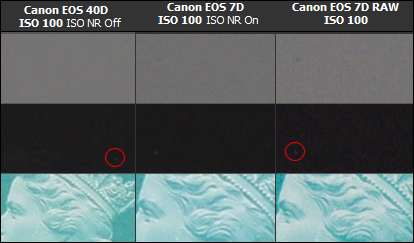
Here you can see that at ISO 100, the 40D clearly has less noise, even while noise reduction on the 40D was OFF (!!!) and it was ON on the 7D!! Just check the amount of noise in the 7D RAW file at ISO 100. When has it become acceptable to have this much noise present at ISO 100? I placed the red circles around some dust or marks, I discuss this further below.
As you can see, even at ISO 100, the 2 year old 40D beats the 7D with regards to noise performance. In fact, the 7D doesn’t beat the 40D even with noise reduction on! At higher ISO values, the problem only gets worse. Let’s look at another sample image. I labeled the images below from 1 to 4, 1 being the best and 4 being the worst, as far as noise performance is concerned to make it easier to compare.
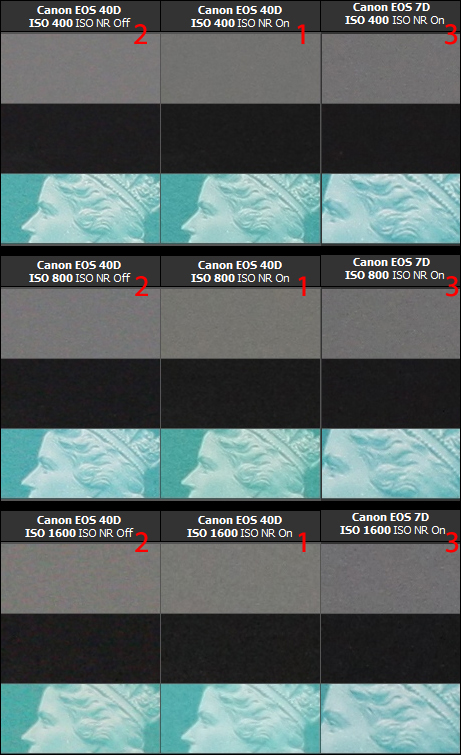
Here you can see JPEG comparisons between the 40D and 7D. As you can clearly see, the noise in the 7D images with noise reduction turned ON (!!!) is still much worse than the noise in 40D images with noise reduction turned OFF. So think of how much worse the 7D images would look, compared to the 40D, if the 7D images also had noise reduction turned off!
And now, let us look at the noise performance in RAW images:
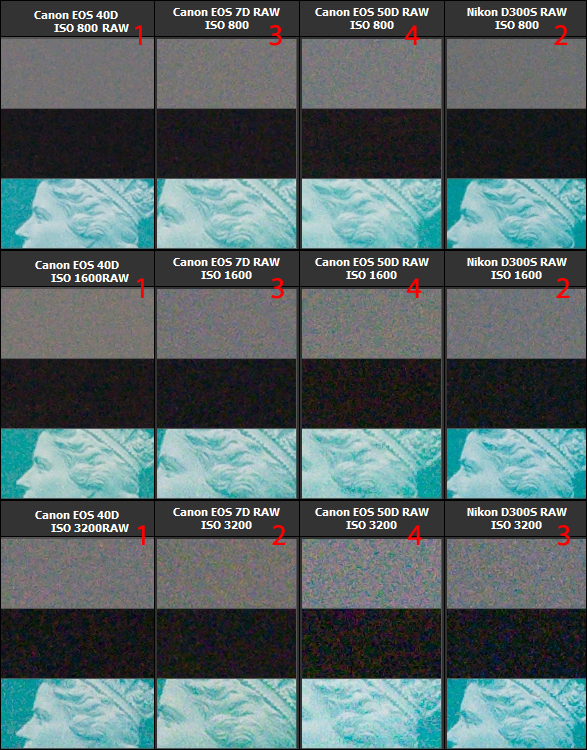
Click on the image to view the bigger version. In this RAW comparison, you can clearly see that the noise in 7D images is worse than the D300s at ISO 1600 and lower. DPReview did not mention this in their review where they discussed these same images. The 7D is much worse than the 40D. Only the 50D is worse than the 7D, but the 50D really is a piece of shit camera to begin with.
As you can see, one can come to “slightly different” conclusions by viewing the exact same test images that DPReview used in their reviews.
Image test results over at CameraLabs also support my conclusions above about the DPReview 7D review. Just look at the image comparisons at these links: RAW Comparison, JPEG Comparison. Notice how the 7D images look so much noisier compared to the D300s images.
This proves that my initial fears about noise in 7D images were certainly grounded. I’ve said it before, but Canon really doesn’t seem to care about what photographers are really asking for. With the 7D they did take care of a lot of things, but image quality is very important. We do NOT want more noise in larger images! This is not an improvement. Now the 2 year old 40D costing round $800 delivers better image quality than the ‘state of the art’ 7D which costs $1700. Does this make sense to you? Not to me!
Canon should have equipped the 7D with a 10MP or 12MP sensor featuring the same improvements in sensor design in the 7D. That would have guaranteed better image quality compared to the 40D. Yes, the 18MP 7D images have more resolution compared to the 10MP 40D images, but really, this is not of much use when the images are also noisier, and especially not at high ISO. It just gives photographers a lot more work to clean up noise in post production. In addition, more dynamic range and other benefits would also have been welcome on the smaller improved sensor.
Since noise in images can be seen more clearly in the out of focus areas, it really makes images that should have nice bokeh effects look uglier. Instead of images with nice creamy looking out of focus backgrounds, you get images with out of focus backgrounds that have kind of a rough and grainy feel to them, even at ISO 100. This can often be cleaned up in post production, but depending on the images, this can add a significant amount of extra time to your workflow. This is why I also always wondered why reviews everywhere on the Internet feature noise tests with images that are in focus. The best way to test the noise performance of a camera, is to take out of focus shots so you can see the noise much better. Take the sample images from DPReview above, for example. The noise test on the gray background should have been done by focusing on a large gray area, and putting the lens totally out of focus. That way you don’t get the dust, patterns and other texture of the background together with the noise – something you can often see in the DPreview noise test images (check the red circles in the test images above). You could even confuse the texture on the background as being noise if you don’t look carefully.
If you’re wondering why Canon isn’t giving us what we want, check out this article:
Canon engineers are being held back from developing new sensor technology by marketing departments in a “race for megapixels”, claims an employee of the Japanese photography company.
The employee told Tech Digest that Canon have the technology to “blow the competition away” in terms of image sensors, but are instead being asked to focus on headline figures like the number of megapixels a camera has. When asked for his opinion on the Canon EOS 5D Mark II, which we covered this morning, the employee said:
“I am hugely disappointed because once again Canon engineers are dictated by their marketing department and had to keep up with the megapixel race. They have the technology to blow the competition away by adapting the new 50D sensor tech in a full frame format and just easing off a little on the megapixels. Although no formal testing has been done on the new model yet, judging by the spec and technology used, it just seems to be as good or as bad as the competition – not beating them by a mile (which we used to).”
The employee was keen to point out though that he wasn’t wholly disappointed by the new model though:
“The image quality on the 5d1 was so good that it’s still as good as the new NikonD700 even though the Nikon is 3 years younger. I was hoping (…) for two new cameras. One would be a ‘reheated’ 5D1 with a same megapixel count but a slight redesign in sensor combined with new processor and all the gadgets like micro autofocus adjustments, vignetting control, dust reduction, better weather seals and an upgrade to the autofocus.”
“The other one would be a ‘revolution’ 5d, with a completely new sensor design (so it can actually take a lot more megapixels), dual processor for faster frames per second and the gadgets above with a ‘near’ professional grade autofocus for the sake of protecting the 1D series and model segregation”.
“To be honest I was hoping for a bigger upgrade, but they can’t please everyone with one model. (…) On the whole though, I think Canon have done pretty well in fending off competition on all sides – providing a viable upgrade to the 5d1 and worthy competition (on spec at least) to the competitors”
It’s true that megapixels are often used as a benchmark to compare cameras on, but until the media change their reporting style, the pressure from the marketing department will remain on the engineers.
As we know today, the 5D Mark II also suffers from a lot of noise and banding in images even at lower ISO values, as low as ISO 100. This is just unacceptable. It is very sad to see that Canon, while they clearly have the technology to deliver better image quality, choose to compete in the megapixel race instead and are delivering bad image quality. This while Nikon has just released their new D3s camera with an improved sensor that is “just” 12MP, and fullframe at that, capable of delivering results at extremely high ISO values. Nikon clearly appears to understand much better what photographers really need. Meanwhile Canon is giving us 18MP on a 1.6x crop sensor with a lot of noise at ISO 100, and a 21MP fullframe sensor with noise and banding at ISO 100.
When will we see an EOS 3D camera, with same or better specs than the 7D and a 12MP fullframe sensor using the latest sensor technology, that is capable of delivering smooth, creamy looking images not only at low ISO but even at the higher ISO settings? There’s a reason why people loved the image quality from the old 5D so much. Just realize that today Canon has the technology to improve on that, but simply refuses to.
So to conclude, as far as the 7D is concerned, I’m afraid I can’t really recommend it. It is certainly not a waste of money, like was the case with the 50D and 5D Mark II, as it does offer some nice upgrades compared to previous models. But if you require good image quality, then it is not the best choice. Clearly the Nikon D300s and certainly the Nikon D700 offer more here. If you are a 40D user, you don’t have to upgrade. If you are a 50D user, I feel very sorry for you and upgrading to the 7D is a good option, but downgrading to the 40D is perhaps better and more affordable. If you are a 5D Mark II user, I would consider upgrading, yes upgrading, to the 7D because images that are in focus most of the time win over images with a little more noise in them. Personally I will NOT be buying the 7D as long as the 40D remains available. I will be looking at the 1D Mark IV, hopefully Canon won’t screw up with that model.
Update November 11, 2009:
It is also important to take note of the fact that Canon themselves do seem to know about the benefits of lower megapixel sensors to achieve lower noise and as a result cleaner looking images. When Canon introduced the G11 compact camera, it featured a 10MP sensor, which was actually a step backwards compared to the older G10 camera, which had a 15MP sensor. Why would Canon introduce a newer G11 model which has less megapixels compared to the G10? Here is what Canon themselves say:
The PowerShot G11 employs a newly-developed, 10.0 Megapixel High Sensitivity System by combining a powerful CCD sensor and Canon’s DIGIC 4 Image Processor. Thanks to this technological advancement, the G11 is dramatically more sensitive than cameras with identical megapixel counts, and delivers spectacular images with minimal noise.
If you go over to that page, you will even see the following comparison made by Canon themselves:
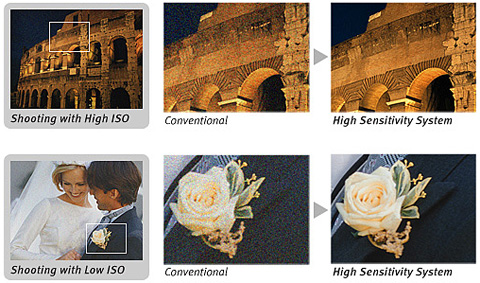
Here Canon themselves show us the benefits of a lower megapixel high sensitivity sensor - cleaner looking images. And yet, they release an EOS 50D camera which had TONS more noise compared to an older model, the 40D. Now they release the EOS 7D, which still features more noise compared to the two year old 40D model. Does this make sense to you?
Now ask yourself, why would Canon equip the G11 with a better sensor with LESS megapixels, that produces better looking images compared to the G10, and still release the EOS 7D, which is supposed to be more advanced than the 40D, with image quality that is clearly featuring more noise compared to the 2 year older 40D? Shouldn’t we expect newer camera models to feature less noise in images?
Update November 12, 2009:
Another review of the 7D has been published showing, and you’re not going to want to believe this, that the 7D performs worse than the entry level Canon EOS 450D (Rebel XSi). Here’s what they had to say:
Again to our eye the 7D files look soft and mushy compared to the snap in the other two files. Of course we expected the flagship Mark III to outperform the mid-priced 7D but we did not expect the entry level Rebel to better the 7D especially when the Rebel’s 12MP files were interpolated to 18MP!
Go over to their site and check the sample images for yourself. Remember that the 450D is now also almost 2 years old.
Update December 2nd, 2009:
A photographer ‘upgraded’ from the 40D to the 7D recently and wasn’t so happy about it:
After a week of playing with my 7D, I noticed the images on my 7D felt a bit soft, especially when comparing it to my 40D. Went online and found some reviews concluding the same thing:
…
Doing my own quick tests, I came to similar conclusions. Using DPP, the 7D produces images that are softer than my 40D at low ISO. I even think the 40D produces less noise at low ISO.
You have been warned.
Update December 13, 2009:
DXOMark have posted their test data for the 7D and you can actually compare the 7D, the 40D and the D300s side by side on their website if you follow this link. The DXOMark test data basically confirms my findings above about the noise in 7D images being worse than the 40D, and that the 40D offers much better image quality compared to the 7D.
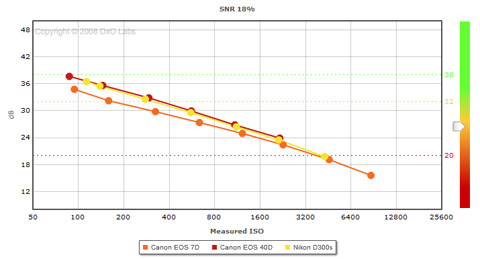
In the graph above you can see that the 7D scores less than the 40D and D300s with regards to noise in images (in the Screen comparison), meaning the 7D has more noise in images compared to the other two cameras. Like I also said, the 40D performs slightly better than the D300s with regards to noise.
Not only does the 40D outperform the 7D with regards to noise in images, but according to DXOMark, the 40D also outperforms the 7D with regards to Tonal Range and Color Sensitivity. This means that the overall image quality is much better on the 40D if the two cameras are compared. Click here to see for yourself on DXOMark.
Imagine what would have happened if Canon had instead improved the sensor in the 40D with the technology used in the 7D. Instead of being behind Nikon, as they are right now, they would have been far ahead.
Hi Karel,
When I first realized the 6-10D’s I and my associates were using at weddings were in fact defective and it was not any other problem than their poor quality I tried in vain to keep using Canon by buying the next and better body and lens from Canon. Finally after owning almost every lens and body in an attempt to find a good combination, I sold them all last year. I didn’t understand why I couldn’t find anyone else that was as outraged as I was, that could see that Canon was perpetrating one of the biggest consumer frauds I know of, and should be sued for selling defective products. I would be interested in participating in such a lawsuit if you hear of one. I don’t have the time or resources to fight Canon although I explain to anyone that will listen about the back focusing problem with Canon digital bodies.
I think it mostly because no one has the time, literally, they are so busy running their business that they don’t have the time to analyze and test their equipment, much less have $20k of cameras and lenses sent in and out of repair and have another set of $20k equipment to use in the meantime. They do what I did, sell everything and just be happy everything is in focus all the time, in all the shots under all conditions at any ISO using any of the focus points. The older generation attitude that would normally be outraged at this type of thing and pursue it in the courts and through professional organizations isnt so prevalent, even with the information we have to corroborate the evidence. I wrote Canon some detailed letters, and copied some to management when I sent in repairs, and it got some results, but after a while the repairs didn’t work and I just couldn’t use the stuff. I had a $1700 14mm lens that wouldn’t take a photo unless I turned off the camera, partially unmounted the lens, remounted the lens and turned the camera back on. After I sent both the 5D body and the 14mm lens in for repair, it did the same thing. This was the last straw after years of calibration, repair and upgrades.
“Canon should have equipped the 7D with a 10MP or 12MP sensor featuring the same improvements in sensor design in the 7D. That would have guaranteed better image quality compared to the 40D. Yes, the 18MP 7D images have more resolution compared to the 10MP 40D images, but really, this is not of much use when the images are also noisier, and especially not at high ISO. It just gives photographers a lot more work to clean up noise in post production. In addition, more dynamic range and other benefits would also have been welcome on the smaller improved sensor.”
While the swatches you show may reflect what you’re saying, The dpreview swatches may not be directly comparable – they change their setups and it may not be feasible to run a comparison this way. The only good way is to take both cameras and run the same test under these situations.
Moreover, the real issue is whether or not the noise performance at iso 100 is bad. I would say that it is fantastic, no matter the comparisons.
I think DPreview was correct in their assessment concentrating on high ISO noise. Low ISO noise on DSLRs – and even some compacts – has pretty much never been an issue – it’s just when the ISO range is boosted that noise starts to become a problem and this is when it really needs to be cleaned up in post.
Lastly, it all depends on your output.. if your output size is the same, the 7D’s individual pixels will be much smaller, and therefore, noise issues (if they even exist) would be much harder to see… keep in mind that they have 80% more pixels on the 50D to play with.
As for autofocus, I haven’t experienced any issues whatsoever with my 7D.
If you aren’t able to get good images out of any of the models you mention in the article, you might want to start looking elsewhere for why the photos aren’t turning out well.
A few things to note:
1. ACR does not full support the 7D yet, so ANY ISO comparisons made up until that point should be null and void. We’re dealing with beta camera profiles right now that are not doing these files justice.
2. In the beginning I was convinced that my 7D has focus issues, when in reality I had to get past the learning curve with the new AF system. I had to essentially change the way I shoot, which IMO is better now with the 7D. Once I mastered it’s AF system, I am still completely blown away by the files coming from it.
Mmm. Higher noise, true, but not TOO bad – look at my blog for some samples at 100-800 ISO. And with the advantages (pop up flash, better focus system, etc) this is still a good camera. I use it next to my 1Ds MkIII and 1D MkIII.
And Nick is right w.r.t. the profiles. Use DPP if you want a fair comparison.
Karel:
7D Noisier than 40D? With 80% more resolution, that’s totally reasonable and why do you have to repeat a common sense? If you think 7D should have lower or the same noise level as 40D, aren’t you asking for a bit too much?
The reason behind producing a higher resolution sensor (aside from marketing purposes) is that shooting at lower ISO levels, one can obtain more details, as well as more crop margins.
Furthermore, it’s not objective or convincing bashing a new product before you actually get one in your own hands and test it extensively. Please provide some original test proof from your own evaluation – that’s my only suggestion. The gathered info from various online sources that you post here don’t give us anything that we already know.
BTW, here’s some more test *other* people did to counter your selective info:
http://www.photographybay.com/2009/11/08/sony-a850-a900-canon-5d-mark-ii-iso-comparisons/#more-8696
(7D results are added from ISO1600 and above)
“The only swatches that I added are the ones from the 40D. So the others from the 7D, 50D and D300s are directly comparable. And this is why I included some of these test images to show that using DPReview’s own test images, that the 7D performs worse than the D300s at ISO lower than 1600. But DPReview never mentions this, and they make it seem like the 7D is better than the D300s (it is but only at > ISO 1600). The 7D is worse than the 40D at all ISOs using DPreview’s own images.”
Dpreview focuses on this because noise is at its worse above 1600 and for any camera to perform this well above this is commendable. Personally, this is the range that I focus more on when I’m looking at cameras now.. why? I’ll address this with your other question…
“Why do you say noise at ISO 100 is fantastic? Shouldn’t ISO 100 be free of noise?”
Because I’ve used the camera as much as I could have in the time that the camera has been out and never, not in a single picture shot at ISO 100, have I noticed noise or has noise been a factor in image quality. I would stand by the claim moving up the ISO ladder without hesitation on the 7D.
Again, I would ask Phil if the charts are comparable. I would venture to say no, since I know just recently they have updated their test chart shooting setup, and the 40d’s review is 2 years old by this time and they certainly could have updated the chart even further from that. I see what you’re saying re: the D300s in their swatches, but since I don’t see that in my images, I’m not worried.
Firstly, in their post:
“Removing any in-camera noise reduction and processing the images using Adobe Camera Raw (V5.6 Beta in this case, all NR set to 0) gives us the nearest thing to a ‘level playing field’ for assessing the relative noise levels of the four cameras’ sensors.”
Since the D300s’ is using the same sensor as the D300, My guess is that Adobe Camera Raw by this time would be handling the D300s files much better. And the fact that they are using a beta camera raw that may or may not even be compatible with the 7d makes these comparisons a little bit useless. I would definitely count this against DPreview on this point – they shouldn’t have published a review or conclusions based on beta software.
“The Pentax K-7 is much closer to the pack but it also becomes clear that the 7D produces a cleaner image than the 50D and, at very high ISOs, also than the D300S.”
While I agree they do not comment on the D300s appearing better at lower isos, they don’t try to claim otherwise, clearly stating the advantage is only gained at high isos. I don’t believe that they are really being misleading here.
“I agree with you that low ISO noise on DSLRs has not been much of an issue before. But with recent product releases, certainly by Canon, it seems that noise even at very low ISO has become the standard. This is a bad trend.”
Don’t get me wrong, I completely understand the whistleblowing. If the ISO 100 performance of the Canon 7D was noticeably worse in all cases in actual photos, then I would be trumpeting the same horn. But I just don’t see it my photos, so I don’t think it’s an issue. And in my experience, pictures I’ve shot at ISO 3200 on the 40d came out noticeably worse than the 7D, and the 7D allows me to go even further up from there. I cant disagree more with your assessment of the 7D versus the 40d, having had time to shoot with both. I would recommend any 40d owner to try it out.
What is noticeably clear despite all this, is that despite the resolution gain, the 7d is doing very well, and is clearly coming out better in all cases than the 50d.
My last point about noise – your position would be a lot more credible if you had set up your own test chart setup and shot it with both cameras, instead of using DPreviews… I would say you’re on shaky ground with fair use and showing your own examples would just clear the air completely in this regard.
Nick Haskins above raises a good point about autofocus as well:
“In the beginning I was convinced that my 7D has focus issues, when in reality I had to get past the learning curve with the new AF system. I had to essentially change the way I shoot, which IMO is better now with the 7D. Once I mastered it’s AF system, I am still completely blown away by the files coming from it.”
I’m not convinced that anyone has really had sufficient time to master this new AF system. I can’t claim to either – what I have noticed is that it is extremely sophisticated and there is a huge breadth of options, especially when dealing with AI Servo tracking. I’ve been able to find a setting that works very well for me, but I’m sure the more I use this camera, the better I’ll get at it. The fact that it’s been out for maybe a month and people are claiming definitively about its autofocus tendencies is a little troubling, especially since it’s a completely new system that no one up until now has ever tried before.
Lastly, your point about quality control is a little dubious. Nikon has had it’s own share of problems as well – no manufacturer is exempt from this. It’s just good that Canon was able to test enough that the problems that have come out so far have been fixable via firmware, rather than a hardware recall. What’s noticeable to me is that not a single review before 1.0.9 or 1.1.0 has pointed out either of the problems that canon fixed… and most certainly, I didn’t notice either of these problems… and certainly with the residual image problem – I’ve never even seen it demonstrated, let alone show up in any pictures of my own. I’m also still not convinced that the AF is a widespread problem. Nor do I believe it was a problem on the 40d, 50d, or 5d Mark II. I think those cameras were just using an old AF system. The only camera I’m convinced that had AF issues from Canon was the 1D Mark III which had clear hardware issues that canon had to fix. The reason above all that I think your point in mentioning canon quality control is dubious is because I don;’t think the models you referred to has any bearing as to whether or not the 7d is a good camera, especially in a “review” as this post is titled. Sure, you may have not liked the 5d mark II’s autofocus, but that doesn’t make the 7d’s autofocus worse. Photogs are a discerning bunch, and I think i’ve seen people claim quality control issues on the most expensive lens and camera equipment imaginable – while others use it day to day and just make pictures.
“Thanks for the long reply. It doesn’t matter why DPReview focuses on the higher ISO results, my point was that they failed to mention the low ISO results between 7D and D300s, and I felt I needed to point this out.”
I think the review would be extremely exhaustive if they had a detailed commentary on every possible comparison. It’s much more useful to view the samples and make your own impressions, which is why it’s valuable that they post these comparisons and I believe they commented on what most people would be looking to read.
“Also if I understand correctly you have both the 7D and 40D? Perhaps you could post some samples of your own for us to compare.”
I no longer own the 40d, but I shot some photos within the same extreme lighting situations that prompted my opinion that the 7d performs much better at high ISOs than the 40d. These were not during shoots, but during my own personal shooting where I frequent the same locations at the same times of day, and notice myself comfortably shooting very high ISO. I think it’s safe to assume canon feels the same way, as ISO 3200 is an H mode on the 40d, and ISO 12800 is the only H mode on the 7d. The fact that the 40d cannot natively shoot ISO 6400 supports my impressions.
“Also agree with you regarding the 7D being better than the 50D. I mentioned this too, but really, image quality on the 50D was terrible. So it is no surprise that the 7D is better. Just look at the RAW comparison on DPReview.”
I haven’t tried a 50d out for a long period of time, but I believe this camera gets a lot of undue flak. To say it’s terrible is a little bit of a stretch.
“Sure Nikon may have it’s own issues, I never say that they don’t. But even if Nikon had the same issues, it doesn’t mean that Canon can have those issues too. They should be capable of delivering better quality in my opinion. This gear costs money.”
All this gear is expensive and none of it should have any problems. But they have and they do. It’s just a matter of how the companies go about fixing, how fast, and how much of a hassle it is on the consumer to fix said problems. Updating firmware is hardly a hassle.
“I don’t think there is a specific format for reviews. My posting style here is more like a conversation, and so even if I am doing a ‘review’ of the 7D, I can discuss related topics too or mention them in passing. Just to give some more background etc.”
I agree you can take whatever format you wish, but there are some formats that are more effective than others. Certainly, owning and having shot extensively with the cameras mentioned before you form impressions gives a lot of credence to said impressions.
If you really feel this image quality will be a huge issue, you’ll either have to go Nikon or get stuck with a camera that is significantly less capable (which at this point is any Canon camera but the 7D or 1D series, in my opinion). Feel free to not upgrade if you don’t feel it will help your photography, but if you really feel that this camera is as promising as you say, grab it from a dealer that has a good return policy and return it if it doesn’t perform up to par. I’m willing to be it will, but different strokes for different folks.
Nice tests…
I must be the “Golden Child” since i have NON of the above mentioned issues…
The only thing i had was the ghosting that occured seldomly in burst mode (8f/s). This is gone due to the firmware update.
We compared noise behavior of the 40d and the 50d with a 7d and the winner is definitely the 7d (only tested raw since none of us ever uses jpegs out of cam).
But like i said before…i must be very lucky…
I have the strong feeling the author is a little bit of a Nikon-Fanboi…
The post about not talking the pics off of your page after being asked by dpreview just killed me…Dude!?!
This reads like so many threads on DPReview. OMG teh noizez!! But in the samples you posted, you really really have to squint to see what you’re talking about. More importantly, you ignore the basic fact that with an 18mp image, you’re enlarging the image less when you print.
I actually own a 7D. I’ve had none of the AF issues others are talking about, but of course that doesn’t mean others haven’t. But when it comes to image noise, it’s the best I’ve ever seen from an APS-format camera. I also own the 40D. Guess which one I take out when I want to shoot in available dark? The 7D.
Why? Because I’ve actually printed images from it. That “noise” you’re pixel peeping does not show up in print. ISO 3200 from the 7D prints like Tri-X from a film camera. A medium format film camera, that is. Very tight, random grain at 12 x 18″. Even 6400 prints well, if the photographer has done his job and exposed the image correctly.
All the pixel peeping in the world doesn’t change the fact that prints from 7D files look excellent. Even 12800 look remarkably good, if the photographer knows what he’s doing.
The most important thing about it is that the pattern noise that has plagued Canon cameras is almost completely gone from the 7D. You have to really twist the pixels around to get it to show up. I can’t say that about the 40D.
It’s amazing how picky photographers have become about high ISO noise. I’m convinced they’ve either never shot film, or just forgotten how 3200 speed film prints. Here’s a hint: you wouldn’t want to print 3200 speed film bigger than 5×7.
I would suggest you stop blogging about the 7D until you actually have one yourself.
steve
My god…. You’re obviously a
nikon fanatic. Bashing the image quality and iso performance of the 5d mkii in the same review of the 7d, that you’ve never touched. I actually owned a 40d, 50d and now own a 7d. I’ve taken thousands of pictures with each of them. I can tell you hands down, the 7d beats the 40d and 50d in just about every way including image quality and noise performance. Why don’t you at least touch an take actual pics yourself before throwing out such a biased review? My guess is you don’t shot canon camera so you choose to bash them, not knowing any better.
There’s all kinds of problems with comparing the samples you have and the few words out of multipage reviews on a great camera. Try some real world shots or at least taking one picture with a camera before you post a review bashing it’s quality.
Please continue to buy nikon and leave canon alone.
I learned more from the comments herein than the post itself.
All said, I have to agree that this review, which can be interpreted as authoritative across the web/blogo/twitter/RSS-sphere should not have been done. Get a 7D, do your own work–show us what YOU have learned, and then post!
Firstly, I have to say that I own a 7D, and sold a 40D to fund its purchase. I also own a 5D, so bear that all in mind.
IMO, the 7D is not noisier than the 40D. It’s not a scientific statement, just from my own user experience. I believe it even comes close to the old 5D. When I had the 40D, I was very reluctant to shoot 1600 and God-forbid 3200, but with the 7D it really looks so much cleaner. If that’s from NR then it’s pretty good NR! But I think the x-factor here is its dual processor. Like I said, not a scientific statement.
The 7D really is almost an immaculate upgrade from the 40D. More resolution, better LCD, and the sweetest parts are the better AF and video capabilities. The 7D costs more than 2 40Ds, but I believe it is worth it.
Karel,
1. God Almighty man!!
2. How can you give such a scathing review to a product you have never touched?
3. It took me a while to catch on that you have never even held the 7d in your hands
4. Unbelievable!
5. Your opinions are not credible until you, yourself, have put the camera to test.
6. Anybody reading this review should do so with a great deal of SKEPTICISM!
7. Dpreview has been one of the most trustworthy camera reviewers on the web – I don’t think they would destroy their reputation by putting a tainted review online.
8. Have you noticed that most of the forum members on Dpreview have thought, for a long time, that Dpreview was biased against Canon.
9. Consumers want unbiased reviews – your review is not an example of an unbiased review!
10. Finally, what beef do you have with Canon?
The main thrust of this article is a “7D Review” (a camera which you have not even used, but that’s another point entirely); it was not a critique of the DPReview review. You could have easily included a link to their images instead of embedding them.
I can see why you see it as a gray area for fair use, but in this case, you should link their work, which represents a tremendous amount of work on their part.
Hi Karel, I appreciate your comments about the 7D and the other cameras. You’re absolutely right about your observations. Dpreview’s review of the 7D shows a favorable slant toward the 7D even though the images show it to be worse than the 40D and Nikon D300. The Canon 7D ads on Dpreview probably have a lot to do with it. Dpreview doesn’t want to bite the hand that feeds them.
“as for the 40D and 7D, too bad you don’t have the 40D anymore. It would be nice to see some RAW comparisons. Perhaps your 7D images do look better but are you shooting jpeg or raw? Because the Jpeg setting might have high noise reduction turned on.”
I rarely ever shoot Jpegs, and even when I do, I never have noise reduction on. If I were to ever remove noise, I would want to do it myself. In this case, as mentioned above, I’m seeing significantly worse noise in the photos that I took at ISO 3200 on the 40d (the H range of the 40D) versus the 7d. This is from my own experience, shooting raws, wide open, a the slowest possible shutter speeds at the worst lighting conditions possible. At the very best, I certainly don’t see the 40d outperforming the 7d, and in most cases, I am seeing quite the opposite.
“Well what happened to buying something and having it just work as advertised? Why spend time having to update firmware or send equipment back to Canon? Look at what happened with the 1D3.”
Name me one digital camera that didn’t have a bug fix firmware update. I understand your point of wanting it work as it should, but more often than not, it just doesn’t happen. Ideally the problems that do come up just won’t affect the type of shooting that you do.
“I agree with this, but one does not always have to own something to comment about it. In this case I provide enough source material for readers where they can see based on what I say certain things. They can view that source material themselves over at DPReview and form their own conclusions and see if they agree with me”
Yes, but seeing test charts and graphs is completely different than going out and shooting with the camera according to your actual needs. My point being that even if the charts look worse than you’d like, you’d think that in real life the camera would match those conclusions – but in my own experience more often than not, the things that people niggle about on these charts doesn’t bother most once they see the photos they get back. The camera for all you know may hold up to your exacting standards and you might never even know, if you haven’t tried it in your specific setting. The same holds true for many lens review forums – people complaining about focus shift, sharpness and aberrations. Depending on your photography, this could be killer – a done deal. But for some, you’d be surprised how little a difference these things actually make.
Ideally we’d have a super clean ISO 102,400 @ 72mp, but we can’t. But what we do have is a camera that manages to compete fairly well @ 18mp, and offers up to ISO 12800. This is detail at a noise level we’ve never before seen, especially at this price. Again, I would strongly recommend trying it out, but that is entirely up to you.
I have owned a Canon 30D,40D and 50D all I can say is My 7D is in a different class to them,
so rather than slagging off a camera you have never used and reviewed, why don’t you get your hands on one and use it for what it was intended for to record images?
When I do a photo job or sell a print the customer doesn’t give a fig about the camera it was taken with, the only thing they worry about is the image. The images I’m producing out class any other images I have produced with other Canon or Nikon camera’s I have owned. I agree with one of the other replies that compared to film cameras and high speed films you don’t know you are born.
The final word
The Canon EOS 7D is a camera that can convince in all areas, and at its current pricing is going to be a very serious competitor for Nikon’s flagship APS-C DSLR, the D300S. It offers excellent image quality in all shooting situations and an impressive speed of operation, combined with very good build quality and ergonomics. Both its specification and the results of our testing make it a very easy recommendation.
Detail (D-SLR) Rating (out of 10)
Build quality 9.5
Ergonomics & handling 9.0
Features 9.5
Image quality 9.0
Performance (speed) 9.0
Value 9.0
Highly Recommended
Say No more…………..
Another relatively objective analysis. It’s damned hard to find objective, thoughtful reviews or analysis on the web, so I appreciate this.
I think part of the problem, and why you stir up so many people to self-righteously talk about their wonderful experiences with the 7D or 50D or 40D is that many people simply do not use their cameras close to the limits. If you only take minimally cropped shots of large objects like people, then you’ll have no AF issues and you’ll not notice noise in normal prints. So you can storm around in places like this and berate “pixel peepers” and again be smug and tell people to get out and take some photos. Commonly this comes from sports photographers, but sport photography is a doddle compared to, say, some bird photography.
In particular in this discussion, people keep discussing hi-ISO performance, despite the fact that everybody including Karel are convinced that the 7D is better than previous xxD’s in this department. It’s not an issue. BUT, why is it not also better at ISO 400 or 100? I don’t understand this and didn’t understand it with the 50D. I spend a lot of time on my ISO 400 shots cleaning up incredibly noisy skies on sometimes highly cropped images and was expecting new and improved and more expensive 7D to improve on this situation.
I have the 50D, previously 40D (tried 3 of them), 30D, 20D, 450D and 300D for varying periods of time. I can confidently say that critical image quality in the circumstances that I often shoot is WORSE on the 50D than the 40D and both are worse than any of the others, perhaps with the exception of the 300D. In fact for focus accuracy on small targets and/or in bright light and/or at long distances, and/or in the presence of competing clutter near the target, the performance is almost the reverse of the modern-ness of the camera. My 20D stands out as being the best at photographing small targets at long distance in bright situations of the lot.
Somewhere Canon is getting it wrong, and this is not just conjecture. They have admitted that their focus systems have been flawed in recent models (again, we are talking about CRITICAL focus on difficult targets, not your average day to day weddings or (IMHO) sport — though sports photographers have been some of the loudest in complaining). Canon have sweated blood in the last couple of years to completely and publically re-design their focus systems starting with the 7D. This is clear evidence that something was wrong, and not just in the 1D3.
The endless pursuit of Megapixels in the xxD range is just painful and leaves all of us with reduced quality images, more work to do to clean up highly cropped images, more processing power and more time to process images and more storage required to store files that are much larger than they need to be.
To prevent being mobbed, if I didn’t own a swag of Canon lenses or if I had infinite resources, yes I would definitely switch to Nikon. At this time Nikon seem to have their sights more accurately set; they don’t seem to be blinded by the need for pointless megapixels and seem to manage to produce mid/higher-end cameras without fuss that give superior image quality and that can focus predictably. I regularly check photos of wildlife on flickr and other forums and find recently that almost always when I see a technically ‘really good’ photo (focused, high detail, no plastic smoothing, reasonable noise) that it has been taken with Nikon, or even sometimes Sony. This is not what I observed a few years ago.
Good on you Karel, keep up the thoughtful insights until Canon get their act back into gear. BTW I have no beef against DPReview except that I haven’t found their reviews to be particularly insightful or objective.
Karel,
I find it funny that many commentators here seem to put their trust on dpreview but refuse to admit the observation you have made based on the *DATA* from dpreview. Do they truly believe in the *DATA* from dpreview, or do they just blindly believe in the *WORDS* from dpreview regardless of what the *DATA* actually tell?
I believe that your use of dpreview source is completely fair. If this is unfair use, I do not see that we can cite or quote anything from others in any of our writings.
Keep up the good work. This is a very good one.
Where did you get the 40d 7d comparison from that you say is from dpreview?? as they never tested the 7d against it. It was the 50d, nikon d300s and the Pentax k7 on the noise test and no mention of the 40d which is a shame as I own it and wanted to see how it performed.
Oh I see, Its very interesting to see the difference, I own the 40d and have no plans to trade up to either the 50d or 7d, how I wish they would do like the G11 and reduce the pixel count down, just imagine a 10 or 12.2 mega pixel canon with 7d features, nothing would touch it.
After reading this long and extensive discussion I now am convinced to just wear my Puma basketball shoes pump up some air in the soles and jump ship!
I hate to say goodbye to Canon (they have some very good features on their systems), but when it comes to customer satisfaction I see more and more grumpy, disappointed users of the xxD series.
I’m keeping my 40D, BUT I’m purchasing the Nikon D300s.
Thanks Karel, for the enlightenment. I wanted to get the 7D, but after reading all this I’m glad I didn’t.
Karel, i’m just curious (as i’m a Pentax guy, i donn’t really care about the fact 7d is good or not). I agree that 18m pixels is mad. But a Steve said above that he thought the best way to compare pictures was to compare prints. Not 100% crops as 100% crops of two cameras with different pixels counts doesn’t really make sense. I don’t really know if he’s right or wrong but fact is, you haven’t answered to this point.
Great piece. Keep up the good work and insightful analysis. You certainly ruffled a bunch of Canon feathers though. You must have a serious flame-retardant suit and thick skin as well.
It seems that DPReview either “recommends” or “highly recommends” any camera reviewed on its website. There has been debate about the objectivity of DPR and other review websites, especially when they get “previews” and first dibs on cameras, all subject to non disclosure agreements/NDA’s (e.g., Leica M8 and not noticing the infra-red/magenta issue). IIRC, DPR recently complained that various rumor websites were stealing the thunder of new camera releases (and affecting DPR traffic), while DPR was barred due to NDAs. Recently, DPR has made some wonderful declarations about Leica’s M9 (IIRC, DPR was invited to preview the camera in Germany) and noise improvement. Yet looking at Preview sample pic #5 (ceiling at ASA 1600) shows substantial noise. Certainly does not create any confidence. You really can’t bite the hand that feeds you.
To me as a layperson your use of portions of DPR’s 7D “review” is fair use and fair game as long as give proper credit–which you did.
Thanks again for the article.
BTW, Amazon bought DPR for an undisclosed sum in early May 2007, according to crunchbase.com (this may be old news to many, but new to me), through http://dpreviewsucks.blogspot.com/
http://www.crunchbase.com/company/dpreview
From webpage: “Amazon acquired the company in early May 2007 for an undisclosed sum. At the time, the website had over 7 million monthly unique viewers. About dpreview, Amazon CEO Jeff Bezos said “dpreview.com is by far the most authoritative source anywhere for straight talk about new digital cameras” (I believe quoting is fair use)
So, of course DPR has to play nice and soft-ball any negatives/issues–otherwise a bad review by DPR could affect Amazon’s sales as well as relations and supply with makers/distributors/suppliers.
Thank you, Karel! Very insightful blog. You clearly defined the data basis of your analysis, therefore I do not understand the complaints that you did not do the tests yourself. It’s a reanalysis, providing additional and useful conclusions not mentioned by the people at dpreview. Great! Everbody can control your conclusions. As far as I can see, all those people criticizing you did not directly criticize your conclusions drawn from the dpreview images. That’s interesting. Furthermore, based on your review I do not see you as biased, as claimed by some people. I understood, that you would be one of the first to buy a 10MP-7D. To the Canon marketing guys reading this blog: I would buy one too, but not a 7D.
Thanks for the laugh. I have both a 5D mark II as well as a new 7D and an older 40D. First of all, the fact that you have a negative review of the 5D2 is hysterical. That is one incredible machine. Secondly, the image quality of the 7D compared to the 40D is like comparing a porsche to a ford. The 7Ds nearly patternless noise absolutely destroys the 40D. ISO 1600 on the 7D compared to the 40D is incredibly better, and although the lower ISO noise is more comparable, ISO performance at low ISOs (FOR ALL CAMERA BRANDS NOT JUST CANON) has not changed in years. Stop whining about canon, pick up a 7D and 40D for yourself, and compare them. Get off your horse and stop trolling the web for negative reviews on this camera, and do one yourself, because as several people have already stated in these comments, the 7D is most definitely not noisier than the 40D. You’re nothing but a troll, and it’s quite obvious. Anyone who is having 7D issues and seeing poorer ISO performance than the 7D either is doing something incorrectly or has a defective unit.
Have to agree with Ryan.. have used the 40d for years, and recently upgraded to the 7d. The assertion that the noise in the 7d is worse than the 40d is laughable, and really shows a complete ignorance on your behalf. I am able to shoot at ISO 800 without the horrible banding noise that I had to put up with on the 40d, and that in itself is worth the money.
Add to it the responsive AF, awesome screen, handling and resolution, and I’m a happy camper. I’m not asserting that the 7d is better than the D300. But I’m really worried that that you assert the 40d had better noise level than the Nikon… WTF?
Just to be clear, so I completely understand your point of view: Are you saying that if the exact same scene were shot with a 40D and a D300s and a 7D, and all the shooting parameters were exactly the same, and the scene filled the frame exactly the same on each camera, that if I took the three image files and printed them each at 40″ x 60″ on a Canon IPF printer (or Epson) such that the image filled the print frame exactly the same in each case, that I would see more noise and less dynamic range on the 7D print (that required less enlargement) than on the prints coming from the 40D and D300s (that required more enlargement)? I am more interested in this result, than whether or not at 100% view on the monitor one looks better than the other. In any event, I do agree that camera companies should stop promoting better noise performance on their most recent products, unless they preface that by saying “at a given fixed print size”. By not saying something along those lines, they are giving people the impression that with higher resolution cameras that they will be able to print at correspondingly larger print sizes with less noise at those larger print sizes than the older lower resolution camera can print at correspondingly smaller print sizes, which is not true, apparently.
I do think it is worthwhile to look at the 100% views on the screen to see if, at the stated maximum resolution of the respective cameras, there have been gains in minimizing noise at the individual pixel level. However, pixel peeping at 100% view is normally not the purpose for which photographs are shot. And that is why I am trying to clarify whether or not you think that on 40″ x 60″ print outs on smooth premium revealing papers from unprocessed RAW files, where each camera’s image is printed to fill the 40″ x 60″ dimensions exactly the same from camera to camera (requiring the smaller files to be enlarged more than the higher resolution 7D file), the files from the 40D and D300s will produce a higher quality printed image than the file from the 7D. In responding to my original question, you said “you’d certainly see a difference yes”, but you did not state what the differences would be and which camera would produce the best 40″ x 60″ prints. Instead, you wanted to point out things that could impact the final printed results, which of course, would have to be controlled as much as possible so that would not happen. For the vast majority of photographers, if the 7D does, in fact, produce better 40″ x 60″ prints than the 40D and D300s, then it is the better camera, regardless of what the 100% view on screen is. Please don’t get me wrong; I personally think 18mp is too many and I would be very angry with Canon if they issued a camera that sacrificed dynamic range and high ISO performance just so they could put a bigger resolution number on the camera’s box. I am just trying to get to the bottom of this. Thanks for your help.
Yes, of course one of the differences would be noise. Another difference may be the appearance of small patches of clipped highlights and shadows. Whether or not the photo is viewed as a print or on a computer screen, is immaterial to what I am trying to determine. Most people do not have access to a 40″ x 60″ monitor that would enable them to view huge blow ups of the same image shot on different size sensors or sensors with different resolutions, with each file sized in such a way as to produce the viewable image exactly the same size from one camera to the other on the final output (whether in print or on screen). Given the fact that there is noise reduction software, and software that will downsample and upsample, it is entirely plausible that a slightly noiser high resolution file can easily be made to appear superior than a post processed (originally cleaner) low resolution file, whether for on screen viewing or for print output. What I am still not hearing from you, is a direct answer to whether or not you think the final image at any fixed given size will be inferior with the 7D, or superior with the 7D, as compared to the same fixed size final image from the 40D or D300s. If you really think the final image from the 7D, whether viewable on a 40″ x 60″ monitor or on a 40″ x 60″ print out, will be inferior to the final image produced by greatly enlarging the files of the other two cameras to match on screen or on print, then I would appreciate it if you could just come out and say so. Thanks!
I have no intention of getting involved in this discussion but in the interest of fairness, should you not also post favorable Reviews of the EOS 7D?
Like this one about its Autofocus:
http://www.prophotohome.com/news/2009/11/26/autofocus-torture-test/?utm_source=MailingList&utm_medium=email&utm_campaign=pph+lcd+flip+screen+for+video+thailand+photo+show
Or this one about image quality (RAW is excellent when you use a better Converter program like Lightroom or Phase One Capture One 5):
Canon 7D worse than Canon Rebel XSI? |19 Nov 2009 … Another take on the EOS 7D.. the controversy continues http://www.prophotohome.com/…/canon-7d-worse-than-canon-rebel-xsi/
Cheers!
Peter
This is a good camera for the price. It is simple to use and takes clear, crisp pictures. Also, the battery life is good. And the price makes it affordable to take good pictures.
Anyone who claims a camera to be “a piece of shit” is subject to be very biased, to say the least, or just wanting to have attention, but it’s not serious opinion, so you disqualify yourself almost from the start, sorry.
The EOS 50D largely dissapoints regarding to noise compared to what you were used from Canon in the past, but it’s not shit.
But: there will always be guys with an attitude to gather attention, and doing so by all means, what is easier than loud bashing?!
Anyone who claims a camera to be “a piece of shit” is subject to be very biased, to say the least, or just wanting to have attention, but it’s not serious opinion, so you disqualify yourself almost from the start, sorry.
The EOS 50D largely dissapoints regarding to noise compared to what you were used from Canon in the past, but it’s not shit.
But: there will always be guys with an attitude to gather attention, and doing so by all means, what is easier than loud bashing?!
P.S.: no, the EOS 40D is not better than the D300 regarding noise; if you’d take a look at the D300 review you’ll see. And guys like you blame others for giving biased arguments and opress informations.
At the 7D production line a while ago:
8fps: check
large bright lcd: check
electronic level: check
100% viewfinder coverage: 99.99. good enough
hd video: check
bla, bla, bla, bla,: check, check, check.
noise: pardon me?
noise: what noise? I don’t hear anything
IMAGE NOISE!! Oops how much time do we have?
time’s up.
So now what?
oh well, we’ll throw in a couple of FFU’s; that should keep them busy till the next model launch.
FFU’s? Fake Firmware Updates.
Oh
Per picsel – 7D noisle when 40d.
But if you look on whole frame – its equal.
Look on DXOMark site, and ckik PRINT butto on each tabs.
http://www.dxomark.com/index.php/eng/Image-Quality-Database/Compare-cameras/%28appareil1%29/329|0/%28appareil2%29/180|0/%28appareil3%29/336|0/%28onglet%29/0/%28brand%29/Canon/%28brand2%29/Canon/%28brand3%29/Nikon
I also posted some complaints about the noise of images at low iso from EOS7D to lots of forums.
Unfortunately, a lot of people are fully satisfied about the image quality of the 7D, I don’t know what’s the hell before I see your page.
I also did lots of experiments, especially on 50D and 7D under the same exposure settings, and what I’m disagree with you is that, the noise on 7D is EVEVN WORSE than the shit 50D, no matter RAW or JPEG formats, and the review on cameralabs(see: http://www.cameralabs.com/reviews/Canon_EOS_7D/noise_RAW.shtml) also supports my conclusion.
Look at those RAW or JPEG noise comparisions from cameralabs’ review, the noise at LOW ISO of 7d is much worse than that of 50d !!! Because I don’t know how to uplaod an image, if you want, I can email my testing images of the noise levels of 50D and 7D to you.
So my conclusion is, the EOS50D is a noisy camera, noiser than EOS40D, but the 7D is noiser than EOS50D.
To Max:
I had updated my 1000d to 7d and I’ve found that although the performance increses huge enough, the image quality(especially the noise at iso100-400) decreses badly(especially, the grain noise and muddy images at low iso). The CMOS of the 1000d is almost the same as that of the 40d, which produces very low noise especially at low iso.
So what I wanna say is, if you relly don’t mind the image quality at low iso, you can upgrade to 7d, otherwise, the 50d may be a better choice.
Thank you for your honest review of the 7D. I am a 40D shooter and I am very pleased with my camera, but as technology moves forward I look for better high ISO performance with new cameras. When the 50D came out just one year after the 40D with an unprecedented 5MP increase, I blew a nut. Canon had made it clear that they are playing the MP race game when they should be playing the IQ game. When I heard the 7D would be 18MP I again blew a nut! Who the heck REALLY needs 18MP???? My 10MP 40D images sometimes balloon to 600MB when I’m working with them in Photoshop – I don’t need to be working with 2GB files! Not to mention, that I didn’t need to rely on my degree in Physics to know that it would be an ISO noise nightmare! While your view and mine may not be the predominant view at this time, I believe that the 1D Mk IV with it’s lower pixel density than the 7D will fully vindicate us. I can only hope and pray that Canon realizes the error of their ways and backs off on the MP and focuses on IQ. Ideally I would like a 12MP APS-C camera.
Also my wife shoots a Rebel 350 and she is looking to upgrade, but right now the 2.5 year old 40D is the best out there and she is obviously reluctant to invest in technology that old, but the 18MP sensors would require her to invest a couple thousand dollars in a new computer just to handle the files! Canon is really screwing us out of options!
First, I have the 7D.
It’s cool for you and DXO to talk about the 7D as having more noise or comparable noise to the 40D, but honestly, I can’t see the sense in it. If I’m making a photograph, whether on paper or on the web, with the same lens, with the same cropping, at the same display or paper size–the 7D will produce a better quality, lower noise image again and again.
Saying “X is noiser than Y” on *any basis” that doesn’t reflect trying to produce equivalently framed images with otherwise identical gear misses the point, I believe, of what we try and do as photographers.
Moving on, I’ll grab a quote from one of the posters above:
“Who the heck REALLY needs 18MP???? ”
I do. Sports and wildlife shooters, particularly bird photographers, do.
I use two cameras in my work, the 1Ds3 and now the 7D. The 7D replaced my old 1D2N, and one of it’s first tasks out of the box was to follow me down to Bosque del Apache NWR. The very tight pixel density (which is the cause of the higher per-pixel noise) provides quite a bit of opportunity for additional cropping and/or large prints. I make and sell large prints, that’s a real issue for me. Noise levels at ISO 400 and 800 (perhaps you think of these as low ISOs?) are highly usable with modest processing.
Would I have gotten better results with the 1Ds3 and an 800/5.6 rather than the 7D and the 500/4? In some conditions, yes, in some conditions, no–the extra stop the 800 loses in aperture is going to cost me a stop in ISO. Moreover, I can actually physically carry the 500. Given that that that’s a comparison between a $18000 kit and a $7000 kit, it’s not a bad result for the 7D by any means.
Is the 7D a panacea, a camera that’s all things to all people? Of course not. Nine times out of ten I’ll reach for my 1Ds3 (and if I had a 5d2 instead, I’d reach for that instead)–because I tend to shoot landscape, wide-to-normal focal lengths, and those tools would give me the best results. But the 7D is, near as I can tell, one of the best pieces of equipment made today for shooting long for wildlife or sports. I was very impressed with the quality and the flexibility of the 7D’s AF system.
Instead, I’d urge you to think of the 7D as a “1D lite” and the 5D2 as a “1Ds lite”. To frame the debate as “the 1Ds is a better camera” may be true for some subjects but is just as false for others, and the same criticism applies here.
Here, Here, Well said Joe, I think you must be one of the few people who have posted views on this topic who have actually used the 7D for taking photographs. Your own work speaks volumes and it shows you know your stuff. You speak with the authority of someone who uses the camera for what it was intended, that is solely to record what is in front of it when the shutter is pressed.
You touch on another point that I think is relevant when using cameras be they digital or film that is what lens you are putting on the camera body? If you are putting poor quality lenses on expensive bodies then all you will do is highlight how poor quality lenses perform compaired to quality lenses.
As I said in my earlier post, the paying public do not care on what make of camera or how many MP the camera body is. Their only concerns are do I like the image, do I want it ? If you are counting pixels at 100% on your computer monitor and not producing prints then I think you have missed the point ! If you are taking images to store on your hard drive and not produce prints you have missed the point ! Photography is all about producing an image, usually a printed image that is can be viewed by yourself and other people.
In the world of real photographers, who cares if Nikon is better than Canon, who cares if you think the 40D is better than the 70D (in your dreams !!) You should worry about things that matter ie. are you happy with your work? If not why not? is the light good or is it going to rain all day when you have been out at the crack of dawn to take landscapes?
Dear Karel,
I followed your blog occasionally and do you think make thoughtful comments about faults with Canon’s cameras despite me being a Canon user also.
Writing such a thorough and time consuming “review” on the 7D reflects poorly on your judgement:
1) By basing purely on speculations and your interpretation of other poeple’s tests handled on seperate situations such as 40D vs 7D
2) By not handling a 7D yourself or conducting any tests yourself to “back up” your views
3) By referencing only negative reviews and tainted sources such as Fake Chuck and ignoring the positive reviews with the exception of 1-liner disclaimers to appear that you have covered the opposite view.
It is with this damaging piece that you have:
1) Really lost a lot of your credibility, as evidenced by the barrage of critism from many serious photographers including those that have been following you.
2) Shown your lack of experience with “reviewing products”, where you have never reviewed the product
3) Implies that your intent is clearly to damage Canon’s reputation, given the time and effort and sources you have used to piece together this piece. I don’t know if its for self benefit (more hits) or because you are endorsed by their competitors.
It is throughly dissapointing to read this from you. Better luck next time.
To Karel Donk:
Well, actually, I meant that it is 50d.
I mean, 7d is noisier than 50d at low iso, ahthough 50d is worse than 40d.
I did a lot of experiments to show this:
Check out the following links, and you will see that although a lot of people and tests hate 50d, but actually, the 7d is even noisier than 50d.
Here are some comparisions of images out of both 50d and 7d taken by me.
Both using EF-s 17-55 f2.8 lens for testing, with:
high iso noise reduction off,
ALO – off,
picture style – standard (sharpness=3, others=0),
Highlight tone priority -off.
All taken with RAW, then converted by dpp with the best JPEG quality.
MY GROUP1:
first is the 50d’s:
http://farm5.static.flickr.com/4023/4221599238_b850c7e183_o.jpg
the corresponding 7d result:
http://farm5.static.flickr.com/4068/4221599314_b826b8af50_o.jpg
CONCLUSION: Using long time exposures, 7d was noiser than 50d at iso100.
MY GROUP2:
first is the 50d’s (for showing that there was very few noise, I just strengthened the contrast):
http://farm5.static.flickr.com/4012/4221599160_04ce2fb194_o.jpg
the corresponding 7d’s result:
http://farm5.static.flickr.com/4027/4221599100_d08f06a90c_o.jpg
CONCLUSION: Obviously 7d was much noiser than 50d at iso100.
OK, nowtake a close look at the sample photos on dpreview, here are some comparisions:
DP’s GROUP1:
first, 7d with iso 100:
http://farm3.static.flickr.com/2584/4221599370_020d1836fd_o.jpg
from “a.img-dpreview.com/gallery/canoneos7d_samples/originals/img_9207_acr.jpg”
ok, 50d’s:
http://farm3.static.flickr.com/2658/4221599426_ef7910914d_o.jpg
from “a.img-dpreview.com/gallery/canoneos50d_samples/originals/img_5989.jpg”
CONCLUSION: 7d is noiser than 50d at iso100.
DP’s GROUP2:
7d at iso100:
http://farm3.static.flickr.com/2601/4221599476_20ced6b9e4_o.jpg
from “a.img-dpreview.com/gallery/canoneos7d_samples/originals/img_9226.jpg
”
ok, hahaha, 50d at iso400:
http://farm5.static.flickr.com/4006/4221599526_93cb8f50a8_o.jpg
from “a.img-dpreview.com/gallery/canoneos50d_preview_samples/originals/img_0131.jpg”
Karel, you are a bit biased here to say the least ! You put links to threads on your replies too back up your sweeping generalised views on the 7D. All well and good but if you read the whole thread like the one above it appears that the complaning photographer and I use the word photographer very losely, doesn’t as we say in England “Doesn’t know their arse from their elbows !”
It would appear to me and other photographers that you are only interested in negative reviews about the 7D. If your aim in posting such rubbish was to get hits on your site then you have succedded royally ! One final question what gear do you use because your own work doesn’t seem to be of a very high quality !
I believe one can not review a product that one never touches, your review feels horribly biased and feels like an attack more then a creditable analysis, you would benefit from renting the camera or borrowing one, I suspect dpreview accounts more into their reviews then that may be shown in a single web review, no matter how thorough it may seem there are a lot of elements and those change the way the results feel. while results are all the matter you have not discussed anything beyond thumbnails, a photo is way beyond the sum of its pixels and as such must be tested first hand (the equipment is about optimizing your own potential,-enough said about that lol).
As an owner of the 7d for a couple months now using it mainly to take photos of architectural models for college, this being my first major camera i find its results mixed… the overall build is supurb, it is a quality product, the viewfinder is amazing against its nearest competitors, and it is a very fast product. all these elements culminate to form a better shooting environment for the photographer. while I am not as experienced as many people on here I can acknowledge some softness, Im trying to work through whether it is my fault, honestly the mixed results are rather strange, I take tack sharp portraits but just about anything else even in the same field are almost impossible to get at the same level of detail (lens problem?). I am sending the camera in to be recalibrate. noise wise i have a number of classmates with the 40d and used it rather extensively before buying the 7d. There is a huge jump in quality, both is the images i shoot and the feeling i can render. Its a rather strange phenomena, but aside from the softness I find the sort of images I take to change greatly between the two bodies. (the B/W images are some how incredible off of the 7d, I suspect that reviewers take a lot more shots and do a lot more analysis then they document, taking nonstandard shots on their own time, and judging off of them)
Ill update with the recalibration, but overall there is a significant difference between the two cameras more then justifying the price. The video mode in the 7d is awesome and with the right lens a great experience. Lastly I shoot mainly in low light and find that the noise level is more then acceptable, it definitely is visible is Photoshop at 100% but that is why we shoot in digital, (and i have seen a lot worse in film) It is exceptionally easy to make it work, generally disappearing in print anyways. Lastly on the software front, I feel with future updates better algorithms will take advantage of the processing power of those dual processors, and those beta drivers for raw could very well change the game completely with a full release, Im not sure with other camera experiences but it would be interesting to see IQ improvements over the 2yr development process of the 40d- Write an article on that!!
.
Those screen grab ISO test from dpreview does not show D300s noise handling better than 7D rather it is about the same with a slight chroma edge handling going to the 7D. However it does show the 40D with the lowest noise. This said the 7D do have the biggest MP and in theory more details.
Really interesting thread to read. Probably the first person I´ve seen bash the Canon 5dmkii. Not saying I agree, but freedom of speech is super (too bad it only exists in the US, the greatest country in the world, lol). And of course it´s fair use to quote DPreview. Those bastards seem right arrogant imho.
Hi Karel,
I understand your point of view, you see more noise in the 7d pictures.
The noise you´re talking about, in fact delivers much more detail in a3 (11×16) print.
I have a 7d, 40d, 20d, an in the first week i thought that the 7d was inferior in image quality, but when i saw my first print i was completelly blown away.
Very good image quality and with much more detail than the two other cameras i´ve owned.
Print some photos of the 7d and explain the detail, also remember the noise of medium format and the image quality it delivers.
If you want a good camera and do not need to print stick to a compact camera and leave the dslr´s.
This blogs clearly is an eye opener.
I almost ended up buying this body over the weekend as an upgrade for my old 40D but now have to think twice.
If indeed it does turn out that 7D is really that bad compared to what I have now, it will be step backwards. I love my 40D and no doubt it does produce spectacular photos at low ISO.
Considering the cost to upgrade is high, I’d rather save my money and keep my 40D and wait.
Perhaps there will be a miracle model from CANON in the near future….
Vitor wrote:
“If you want a good camera and do not need to print stick to a compact camera and leave the dslr´s.”
I humbly disagree. I want a good camera — in fact, I want a great camera! — and I have no need to print. Compacts are simply not good enough. My 40D can be used for wildlife, sports, landscape, and macro photography, using my assortment of lenses.
The images I gather are shown on websites and computer screens and digital picture frames where image quality and noise issues still apply. In the future, computer screens and digital picture frames will be very big (eg, consider the 27″ iMac).
Hi,, I don’t know you, But this is the first time which only you can tried on iso 100 as most of us beware those only start from iso 200.. after those paragraph i am sure you may not really tested on hand .. but the way to provide nikon… I dun believe your article.. too extreme and unreasonable.. hope if you have any comments,, will reply officially on this blog. onlyif you dare ..
“This is why the D3s rocks”
Pretty much sums it up really. Another biased Nikon user.
Yes, we all know how great the D3s is, but not everyone has the luxury of being able to afford one, so us lowly hobbyists have to ‘settle’ for cameras like the 7D and the D300s. Between me and my Father we own both. I can tell you with no uncertainty that the 7D trumps the D300s in virtually every area. Maybe we got a good one, who knows?
The comments about noise @ ISO 100 are ridiculous. There is minimal noise, and noise will exist in every photo to some extent. You go on to say that you want images that look great on digital displays etc…..Well the only way you’ll be seeing any noise, even at 1600 is if you use a monitor with a resolution of 3000 pixels on the long side, and I can assure you that you don’t, even if you can afford a D3s.
People like you contribute massively to the ongoing gear-head mentality of many of the forums, DPR being an example of what I mean.
It’s about time people took the emphasis off noise levels in 100% crops of 14mp+ images, it’s just stupid and pointless, and it causes silly debates between people that should just go out and enjoy taking photographs.
I couldn’t care less if you have X amount of ISO stop advantage over me, if my camera produces superb results on a 1600×1200 display then I’m happy, and so should you be. I bought the 7d primarily for it’s features, the 8fps, the handling, the build quality, the AF speed and accuracy, the battery life, the options, etc etc. I already knew it would produce great images and it does, but then so does EVERY DSLR made in the last 6 years. Show me one that cannot produce an amazing image at screen sizes with the right glass mounted to it…..YOU WON’T.
Stop baiting the trolls and fuelling the fire. Get out and enjoy the outdoors.
Out of curiosity, where did you find the 40D’s ISO 800/1600 raw images (NR test) from dpreview? I just looked at it now and they’re not there… they got only jpg… plus some Raws at iso 1600 using various raw converters. The iso 1600 Raw from 40D looks better than 7D only because 40D’s has chroma NR set to 25 and 7D is 0… Karel, allow me to have some doubts about the truthfulness of your review…
Luc
I checked and as I said there are 40D Raw images, but only at ISO 1600, and they’re not labeled “40D ISO1600 RAW” as you’re showing:
http://www.dpreview.com/reviews/CanonEOS40D/page19.asp (see bottom of the page)
And raws at ISO 800 *don’t exist at all* on the review. What you’re showing appearing like “40D ISO 800/1600 RAW’ seems to be photoshopped screenshot crops… unless dpreview has changed the 40D review content just few months ago which seems pretty much unlikely.
For completeness, for who has doubts about 7D’s sharpness, may want to look at this comparison with 40D:
http://www.broannutoneparts.com/canon%207d%2040d%20comp/CANON%207D%2040D%20COMP.html
Raw files available for both at any iso. My conclusion from comparing the raws: 40D is sharp, and 7D has the same sharpness – thus preserving more detail, also at high iso.
I used the free Lightroom 3 beta2 for comparison, including its excellent noise reduction algorithm.
7D is indeed slightly noisier at iso 100, this can be easily overcome by adding a bit of NR and detail is not lost.
Luc
I own a 7D and just sold a Nikon D80 10 meg camera. I can tell you all that I was shocked to see “grain” or noise at ISO 100 on the 7D. The 7D is far better then my Nikon at higher ISO’s but at ISO 100 my old Nikon D80 was free of noise even at 200% view. I am NOT a Nikon fan boy. I sold every thing and bought all Canon gear with L lens. The noise does does clean up well but why do I need to clean up noise at ISO 100? I bought the 7D as a refurb and was wondering if Canon may have corrected the issue on later releases?
I have recently bought an EOS 550D, which in theory has a similar sensor than the 7D.
I have been shooting some ISO 100 studio stills of steels tools over pale grey background, and I am really horrified by the amount of noise when seeing the RAW images at 200%.
This is plainly unacceptable, having to process luminance noise for any single shoot, with the risk of flatten out the images.
This camera appears to be amazing in paper (specs) and in DPreview, but the reality is sadly otherwise.
I still hope to find a solution to this.
Karel,
Thanks for writing this blog entry. I’m a fellow Canon shooter and like yourself a very proud 40D owner. I’ve been researching the 7D (now, that’s a camera I REALLY wanted to like) and the 5DmkII for a possible upgrade and I stumbled upon this blog entry. I was totally amazed reading it given that it read almost as a brain dump of my thoughts on it. In particular:
- Image quality? Come on! Did someone say noise? Softness? When it was released, I read rave review after rave review (“excellent sensor”, “EFFECTIVE 18 megapixels”, etc.) and I kept looking at the sample pictures going “are they blind, crazy, or both?”
- How many samples have we seen gloriously showing the 7D having better image quality than the 50D? But, as you pointed out, the 50D image quality was crap in the first place (and the 7D costs almost twice as much). So, what’s the point of that comparison?
- And after their 7D review, I totally lost all respect I had for dpreview (they used to be the best site for camera reviews). I was truly shocked that, after the bashing they gave to the 50D on the dense sensor, image quality (i.e., lack of), etc., they mentioned none of that during their 7D review and kept praising it despite the obvious shortcomings in its image quality which they conveniently brushed aside. Have they gone dumb? I don’t think so. They are just trying to make sure that amazon sells as many 7Ds as possible. Oh, how the mighty have fallen…
Now, the sad fact is that Canon, like the other camera manufacturers actually, want to use their latest crop sensor on all their crop models (see 7D, latest Rebel whatever it’s called, and their latest abomination, the 60D). Out of them, the Rebels will sell most and unfortunately Rebel users get more impressed by more Mps than actual image quality. Most of them could not tell soft from sharp, focused from unfocused, or underexposed from overexposed. But still they feel better having more Mps to take the crappy pictures they take. And sadly this dictates what picture quality the serious amateur cameras, i.e., the ones targeted to the folks who really care about image quality, will also have.
The good news are that the megapixel race is going to end sooner or later. And there is actually precedent. Remember the MHz race? All the chip manufacturers eventually worked out that higher MHz are actually counter-productive and increased chip performance by making other improvements and using lower MHz (well, GHz these days) on their latest chips. The bad news is that it’s not clear how long Canon is going to sustain the megapixel race. And while they do, we’ll keep getting crap cameras with crap image quality. The thought of a 20+ Mp crop sensor is giving me the chills.
Whenever I brought all the above points up in forums everyone thought I had gone nuts (“Canon released a product that it’s less than perfect? How can this possibly happen?!?!?!”). I’m glad that at least someone else is sharing my views on this.
Best regards and happy shooting,
Tony
I am using my phone so this will be brief. I had the 40d for a couple of years and took around 100k photos , mostly of birds with 400 5.6 prime. Got excellent results with raw and dpp. Ended up trigger happy and sold it to get a 7d. After about 30k shots with same lens and of birds, I am not happy with the 7d image quality. The feather detail is not as sharp and the background has more noise in general. Also, the colors are not as rich as the 40d. Anyways, I have my 7d on craigslist and I just ordered a used 40d. I know I will be happy. (one thing that is odd…the screen on the 7d makes the pics look awesome, but on screen the 40d looks better for me…decieving) I do wish the 40d could have the 7d screen, however. I am a pixel peeper ):
I own a 40D and I’m looking for a replacement; The images are becoming softer besides other issues (I think it’s 40D’s swan song).
First of all, in my case, I don’t care if the other brands are slightly better than Canon in a certain camera segment; I’m not moving into Nikon because I have a lot of canon lenses, so I don’t care about Canon/Nikon comparisons.
I’ve done a lot of research and I’ve came to two conclusions:
1. The best replacement would be a 5D MkII. Better image, better ISO performance, better contrast, better dynamic range. It’s a FF, so it performs as expected.
2. The 7D is the 2nd best thing. After all the reviews (by those who actualy own the cameras, not those who heard from a friend or seen on a site)I’ve realised that the 7D is an amazing camera: awesome AF system, very good ISO performance, great features, HD video, flash trigger system, and so on.
And you can’t compare 2 cameras only for their ISO performance but even in this fiel, 7D is quite good and outperforms 40D, as expected: http://www.wlcastleman.com/equip/reviews/7D/index.htm
If it was only about image quality no one would ever buy a 7D, they would buy a 550D; it’s the same sensor, the same image quality and it is a lot cheaper!
So, once I don’t have the money to buy a 5D MkII (and I don’t think we can compare it with a 7D), I’ll get a 7D as soon as I can.
And Karel, next time you try to discuss a camera performance/quality:
1. Get the camera and try it!!
2. Do a lot of more research!!
otherwise you can’t even argue. Shame on you.
(P.S: Pardon my english, is not quite accurate, I know)
7D versus 40D resolution and ISO performance, by Bob Atkins:
http://www.bobatkins.com/photography/digital/canon_eos_7D_review_4.html
http://www.bobatkins.com/photography/digital/canon_eos_7D_review_5.html
I’m a 40D owner and a 7D owner. I shoot a lot of sports and started with the 40D. I’ve been using the 7D for over a year now and I really can’t say that my 40D was a better camera for this. The 40D was fine for action up to about 1600 ISO (but a bit heavy on the pixelated noise). I was happy with daytime shots, but with all the night games and poorly lit stadiums, I needed a camera with better high ISO performance.
I bought a 1Dmk2 and it had a much better sensor than the 40D, but it toped out at about 800 ISO for usable noise. Plus, I needed the 8 frames per second. The 40D was around 6. Unread all of the reviews of how “noisy” the 7D was, but since I couldn’t afford a 1DmkIV, I bought the 7D. I have been extremely happy with it. As long as it is a properly exposed image, I have been able to shoot games all the way upnto 6400 ISO.
I’m not sure what people are looking at, but I could never use the 40D over the 7D. It’s just a much better camera in my opinion. I’m shooting sports for a wire service that I’d never be able to get with my 40D. If you magnify the image to match the pixel size of the 40 D, you’ll see what looks more like film grain than typical sensor noise.
And to compare unedited raw files makes no sense to me at all. I shoot most everything in raw format, but can’t imagine leaving them unedited. That’d be like using unprocessed film! A raw image requires contrast, sharpening and other adjustments to get the most out of the image. My 40 D required a certain amount of sharpening as does my 7D.
I agree that Canon needs to spend more time on high ISO performance compared to high end Nikons, but I’m very happy with my upgrade from a 40D to a 7D.
Canon EOS 7D certainly is a noisy camera. Many people buy it on being a victim of the unprecedented publicity hype. Subsequently they become quiet. Because they are hesitant to admit wastage of US$ 1,600/-. Canon itself has acknowledged that high megapixels are detrimental. They did it by packing less resolution on 1D Mk IV. Its sensor is bigger than 7D but contains less megapixels. Both have dual processors.
But 7D served the purpose Canon aimed at. Many first time DSLR buyers bought it and many Nikonians also fell victim to the hype. However, as I said before, all of them are silent now. I think Canon is going to make another blunder on the upcoming 1Ds Mk IV. Rumors indicate to a 32 megapixel sensor. But Canon, please note, first timers are unlikely to go for it.
“I really do not think I’ve lost any credibility”
I wouldn’t worry about that. You never had any in the first place.
I can’t begin to quantify all the ways you’ve demonstrated your utter cluelessness and infantile bias, but this example will do:
“Noise levels should be checked at the pixel level.”
Nobody who knows what they’re talking about quantifies noise at the pixel level: you’ve obviously spent enough on DPR looking for “proof” of your tiny-minded prejudices to have seen any number of explanations for why quantifying at the pixel level is the most idiotic, wrong-headed thing to do.
My God…
But to make the point: the following are 6400 ISO and 12800 ISO images, taken by me and my 7D, with no “magic” to the processing, and yet – and I’m typing this slowly so that you can keep up – you’ll not find better IQ in any crop camera available today, and certainly not at these ISOs. The D7000/Pentax K-5/Sony A850 sensor has caught up, but they’re only now reaching the IQ of a sensor that’s almost three years old.
http://www.capture-the-moment.co.uk/tp/tfu29//upload/Lr-2047_6400.jpg
http://www.capture-the-moment.co.uk/tp/tfu29/upload/Lr-2377_12800a.jpg
The Exif is in both of the files – they’re real low-light images, taken handheld with the 50mm f/1.8 – and they demonstrate pretty damned conclusively that you don’t have a clue
Karel, your approach to noise is quite limited, and is incorrect in many cases. Allow me to illustrate why.
If Canon came out with a 972×648 pixel DSLR tomorrow that had a 4 stop advantage in noise over your 40D on a per-pixel basis, would you say that Canon had produced a vastly superior DSLR to the 40D in terms of image quality? Would you buy such a camera if they produced it? Why or why not?
My guess is that you wouldn’t buy such a camera, and you might not even praise its low noise, for that matter. Why?
Because if you downsized your 40D images to the same resolution as that hypothetical camera, you’d get exactly the same amount of noise as that hypothetical camera, on a per-pixel basis, when comparing the downsized shot from the 40D and the native shot from the hypothetical camera. That’s because your 40D has 16 times the resolution of the hypothetical camera — 4 stops more resolution, in other words.
If you don’t believe me, try it: take a high ISO 40D image that you shot, and downsize it to the resolution of the above hypothetical camera, and compare the per-pixel noise in the resulting image against the original. You’ll see that the noise has been drastically reduced. How do you explain that, if the only valid way to measure noise is by examining the per-pixel noise at the native resolution?
Now, if it’s the resolution that the camera produces that matters to you, then you can use mRAW on the 7D. That produces exactly the same resolution that the 40D produces: 3888×2592 pixels. That means you can do a real apples-to-apples comparison between the 7D and the 40D. And I’m here to tell you that at ISO 100, the resulting shots are essentially indistinguishable in terms of noise in the blue channel, where the 7D has the greatest disadvantage (you can tell by examining the blue sky and comparing the noise between the two at 100%, when looking at areas that have the same color values). The noise signature of the 7D in mRAW looks even better in the red and green channels. At high ISO (ISO 1600 and above), the 7D shows a very noticeable improvement over the 40D: it’s at least a stop better.
How do I know all this? Simple: I had a 40D at one time, and have a 7D now. I have all of the original RAW files from my 40D. I can postprocess them using the same program as I use for my 7D images. This means I can examine the noise at 100% just as you’re suggesting we should do. I also have mRAW shots from my 7D, and can create more at will. I can examine areas of a given tone and compare them against areas with that same tone generated by the 40D. When I do, the 7D’s noise signature is at least as good as that of the 40D at ISO 100. At much higher ISOs, it’s no contest: the 7D clearly wins. Even better, I can duplicate some of the higher ISO shots (e.g., ISO 1600) I took with my 40D, using the same exposure setting, environment, subject, and framing. When I do, the 7D walks away from the 40D — the noise signature is at least one stop better on the 7D at ISO 1600.
You say that printing doesn’t matter, and for you it might not. You say that these days, people share their images on the web. Well, guess what most of them do with their images when they share them on the web? They downsize them! Downsizing an image reduces its noise signature. More to the point, regardless of the camera, they generally downsize the image to the same resolution — independently of the original resolution of the camera. That’s the same thing as printing from various cameras to the same print size.
If you want to maintain at least as good a noise signature with the 7D as you do with the 40D on a per-pixel basis, the above gives us insight into how to do it. The 7D and the 40D are essentially equivalent at ISO 100 at 10 megapixels resolution (actually, the 7D has a slight advantage here). If you want to achieve the same noise at ISO 100 that the 40D gets, just shoot at 10 megapixels (mRAW), or downsize the native 18 megapixel images to 10 megapixels — the results will be the same (if not favor manually downsizing) if you downsize properly. At some ISO beyond that, the 7D achieves a higher resolution for a given noise signature than the 40D. How much higher depends on the ISO.
If you disagree with any of the above, please be gracious enough to state not only what you disagree with, but specifically why. In particular, please state the use case that would justify limiting one’s noise comparisons to per-pixel comparisons of cameras at their native resolutions (again, the 7D has mRAW, so it can “natively” produce 10 megapixel RAW files if you want it to).
By the way, I should note for the record that I very much agree with you with respect to most of what you’ve said about the 5D mark II. Canon obviously focused more on video than on still photography, and it shows. While the video quality is impressive relative to what most video cameras are able to do, the DSLR platform is a very poor platform to use for video work. Witness the numerous Rube Goldberg contraptions that are available for sale which are intended to deal with the atrocious ergonomics of shooting video with a DSLR.
The 7D is a different animal altogether. With that camera, Canon surprised me greatly — they actually produced a very competent camera! It’s not without its faults — it exhibits vertical banding in the very deep shadows at low ISOs, and has a green channel imbalance as well. Both of those have been mostly compensated for in good RAW converters. Adobe Lightroom 3, in particular, deals with both problems quite well (though not perfectly).
However, aside from the two aforementioned flaws, the 7D is brilliantly executed. And as I noted previously, its noise performance is at least on par with the 40D’s at low ISOs, and is far and away better at high ISOs.
The reason I mention all this is to illustrate that I am not a Canon fanboy or anything of the sort. I believe Canon is run by a bunch of marketing morons who think that World of EOS reaching its 50,000th member is “truly exciting”. This is why the 7D caught me so much by surprise — it’s a significant departure from their usual fare.
Frankly, I’m expecting the 5D mark III to be more of Canon’s usual underwhelming fare. In fact, I will not be surprised at all if it winds up with the same crappy autofocus system that its predecessors have. It’s precisely what I’ve come to expect from Canon. Indeed, even if they improve the autofocus system on the 5D mark III, I fully expect that it won’t cover the rule of thirds locations, as the only autofocus system Canon has that can do that currently is the one on the 1Ds series, and there’s no way Canon’s going to produce something that can compete with their 1Ds line in terms of image quality and autofocus. They just don’t have the foresight for it.
Here’s hoping I’m wrong about that…
I have been shooting with a canon 20d and found my results hit or miss , and most images appeared soft. So i was told that it was my glass so i switched to L glass and still got similar results albeit the back grounds are a bit better, but focus still seemed off , well my 20d just died while i was on my vacation to Yosemite . Anyhow i have been on many sights and asked many questions and when people find out your still having focus issues and are using L glass , well it must be technique , i am using a tripod and trigger release , because that was the next thing people say .anyhow it seems to me reading reviews and going onto sites asking for help that most of the people there will not admit when there is obvisously a problem with canon . Owe and i loved this one – I asked why do i need to do so much editing to get the pictures to look good , shouldnt they look great right out of the body , and i still got soft images using l glass on a tripod , i was then told it was do to a gauze filter on the sensor and that all digital cameras require editing to make images look good . Is this true? If so why spend so much money on bodies that will not deliver from the camera itself . I then went shootiong and saw imaged from a Nikon d300s using a tamron 100-500 i think it was an inexpensive lens and his results were tac sharp, this blew me away . but since my 20d will also look great on the lcd I thought ok maybe they are the same . But what blows me away is that an image can look awesome on lcd but look like crap when viewed on a pc .Anyhow i went again to various sites and was told i need to get a device to calibrate my monitor …all the while the price keeps adding up and i am just a hobbiest looking for better images ,
i was told by a certain canon pro who is a bird shooting expert , no names mentioned , that when i questioned why i constantly see off white or what appears to be blown highlights in white colors i of his images , that i was not using a calibrated monitor and its not the camera being used , i think that was bunk because i see it a lot in my own images. As i think canon seems to meter things in accurate and struggles to get keep highlights from blowing while keeping the shadow details . This can also be caused by to much contrast in the settings . Anyhow i was wondering as my canon has now quit which would be a better avenue to go a D7000, D700 , D300S ,mk5II , or 7D ? I am looking for better focus accuracy and better metering giving me better image qaulity . i shoot a lot in low light and shoot wildlife . Thanks Bill B
I understand what Kevin is saying and have heard this argument before. However, while downsizing a higher pixel camera to emulate that of a lower one will reduce some of the noise, from the look of the comparison made by Steve Huff between the Sony Nex-7 (24mp) and Nex 5n(16mp), it seems there will still be more noise in the higher pixel camera despite that reduction. Check out the link at the bottom.
I think this is a particularly useful comparison because of the proximity these cameras have to each other in terms of release date, company and technology.
http://www.stevehuffphoto.com/2011/10/23/the-sony-nex-7-digital-camera-review-by-steve-huff/
That’s a very interesting comparison. It is possible that reducing the pixel size increased the noise disproportionately for the Nex-7 sensor, but if so it will be the result of an increase in read noise, crosstalk, or some other electronic phenomenon. It is not the result of a difference in shot noise.
That said, I should note that downsizing has to be done properly when the original resolution and target resolution are relatively close, as they are in the Nex-7 versus Nex-5n comparison. That comparison would, if the per-pixel noise were the same between both prior to downsizing, yield a little more than half a stop of improvement in noise as a result of downsizing from 24mp to 16mp.
The reason it’s important to be careful of how one goes about downsizing is that most downsizing algorithms, such as bicubic, tend to attempt to preserve detail. In doing so, they will also tend to preserve noise. In my experience, when downsizing like that, one has to first perform a gaussian blurring pass over the original prior to downsizing. Selection of the radius is, of course, critical in that case.
I don’t know what kind of downsizing algorithm was used for that comparison. I expect it was likely to be bicubic, which is the default resizing method used by Photoshop. It would be very interesting to experiment with both of the original images.
Regardless, assuming that the noise difference isn’t entirely accounted for by the downsizing methodology, the comparison illustrates that, indeed, sometimes more megapixels does yield more noise at a given resolution. Everything depends on the implementation.
The 7D’s sensor does not appear to be noisier on a per-physical-area basis than is the 5D2′s sensor. The reason I say that is that the 7D is behind the 5D2 by about a stop in terms of high ISO noise. Which is to say, the noise signature of the 7D at, say, ISO 3200, is about the same as the 5D2′s at ISO 6400. This is entirely accounted for by the sensor size difference alone, which yields a little over 1 and 1/3 stops advantage in favor of full frame. This means that if you were to take the 7D’s sensor and scale it up to full frame size (which would get you a 46 megapixel sensor), the noise signature of images from it which are properly downsized to match the 5D2′s resolution would be the same as the 5D2′s noise signature.
It’ll be interesting to see if the reversal of direction Canon is taking with the 1DX is universal or not. My prediction is that the next generation of other camera bodies from Canon will at the very least retain the current resolutions, if not increase them. I suspect the decrease we see in the 1DX is an anomaly and not part of a larger trend.
Good article on 7D. Canon made this gimicky camera to earn money and they were 100% successful in that venture. Photographers’ requirements took a back seat. However, I don’t understand why u denounced 50D so much. As an enthusiast I’m using it happily. Shooting in RAW I found it producing good images at upto ISO 1000. Focusing is also good for an enthusiast. Certainly I won’t replace it with sacks of noise (7D) or the childish 60D. Rather wait for the next prosumer model update. With the announcement of 1Dx full frame incorporating 18 mp sensor, I’m temepted to assume Canon might be coming to senses and offer the next action prosumer model with better features that phtogs need.
Clearly the guys at Canon Inc. are not working on image quality and they are not listening to the consumer. How hard headed can a company be?
Luckily I bought a 40D after using a 30D for over 2 years. I’m already looking towards a Nikon D300s or a D700 if Canon Inc. doesn’t come up with a good successor of the 40D.
Those stupid bastards!!!!