
With the release of the EOS 5D Mark II camera by Canon recently, I have begun to wonder if the people in charge at Canon’s DSLR division know anything about photography at all. This camera had the potential of becoming a great hit for many different types of photography. But as it is now, it will only be really useful for studio and landscape photography, unless you can put up with its shortcomings.
One of the biggest problems with this camera is its old and outdated autofocus system. It appears Canon just took the 3 year old autofocus system from the old 5D, made some minor changes and put it into the 5D Mark II. The autofocus system has 9 autofocus points, of which ONLY ONE (the center one) is a crosstype point, sensitive at f/2.8. The other 8 surrounding points are less sensitive, being only horizontal-line sensitive at f/5.6.
This is a huge problem for event photographers and journalists who are looking to use this camera, but even studio photographers who want to use autofocus. In low light situations, it’s going to be a real problem using the 8 outer autofocus points to focus on a subject. Many people have complained in the past about the slow autofocus using the outer points on the old 5D, and you would have expected that Canon would have listened and made improvements.
Apparently Canon hasn’t the slightest clue as to what’s going on in the real world. What’s even more puzzling, is that the EOS 40D and 50D have a similar autofocus system with 9 points, where ALL 9 points are crosstype. Why didn’t Canon at least include the autofocus system from the 50D in the 5D Mark II? The least they could have done was make all 9 points crosstype. It is very disappointing for a lot of people and is a serious handicap for what would otherwise have been an excellent product.
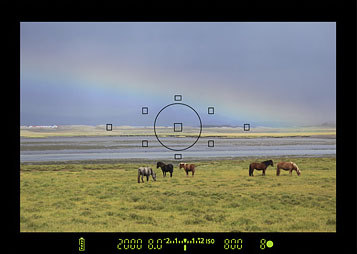
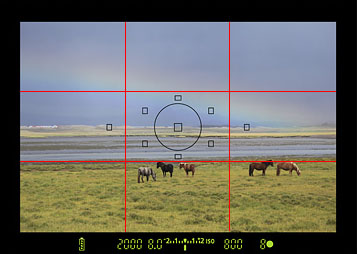
Apart from that, the autofocus points are too concentrated towards the center of the frame. Again, this is evidence of the fact that the people in charge at Canon know absolutely zero about what photographers want and need. With the current layout, Canon seems to expect all photographers to take pictures with the subject in the center of the frame, at least, when using autofocus. What happened to the rule of thirds, Canon? Have you heard of it??
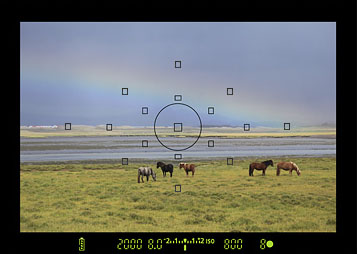
Here’s the layout of the autofocus points on the 5D Mark II as it is now:
Here’s the Rule of Thirds grid on the viewfinder, notice how all autofocus points are concentrated in the middle:
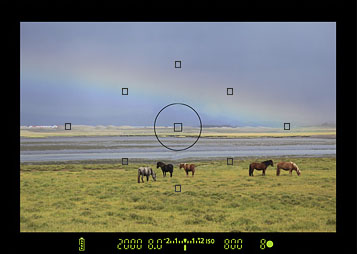
Here is how the autofocus points should have been spaced out:
And here the above picture again but with the Rule of Thirds grid on it. Notice how the autofocus points cover the intersections and every area nicely:
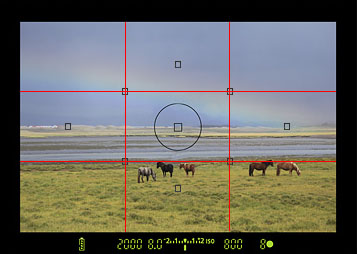
I can’t believe that nobody at Canon thought of this, and that nobody at Canon has gotten any feedback on this way in advance to be able to incorporate it in the 5D Mark II. Are they even making cameras for photographers at Canon these days? Instead of including a useful autofocus system so people can actually use the camera to take good pictures that are in focus, they have instead concentrated on putting HD video recording functionality in the 5D Mark II, a feature that has absolutely nothing to do with helping people to take better pictures. Don’t get me wrong, the video recording feature is a nice feature to have, but I would expect the priorities to have been totally different. Get the core photography features in order first, and then add the extra features like video recording later. And you simply cannot cut back on a core feature like autofocus as badly as Canon seems to have done here.
What makes me really angry, is when I read the following on the Canon website about the 5D Mark II autofocus system:
Three AF modes let you choose the right focus strategy depending on your shooting requirements, and a manual AF point selection mode allows you to activate each of the nine autofocus points manually — a nice touch when your subject is off-center.
I’ve just shown that virtually all autofocus points are concentrated in the center when you use the rule of thirds. I guess they should also have stated how far off-center.
You might say that the fact that the autofocus points are concentrated in the center is not such a big deal since you can use the center autofocus point and then crop later for a good composition, but what is the use of having 21 megapixels on the camera, when you are forced to crop out a large portion of it to have a good composition?? Why have the loss of resolution due to cropping? It would have been totally unnecessary to significantly crop for composition if Canon had allowed you to be able to have a better composition using autofocus points at the time of taking the picture.
You might also say that you could use the center autofocus point to focus, and then recompose the shot. This might work if you are using a small aperture, but if you want to shoot at large apertures, especially when using fast lenses in low light, focus and recompose is not an option due to the extremely shallow dept of field. Recomposing after focusing will give you a soft or out of focus image and that’s not acceptable. In addition, when you have a slow autofocus system like the old 5D, and the 5D Mark II probably as well, focusing and then recomposing gives you an even bigger chance of out of focus images.
So now you have a high resolution sensor, 21 megapixels, but guess what? You can’t easily take pictures that are in focus, eliminating the entire point of having that much resolution available! So now you have a sensor that is extremely capable for low light, high ISO photography, but guess what, you can’t quickly and accurately focus in low light conditions. But hey, you can shoot HD quality video!
I wonder who the people are that decide on the functionality combinations going into a camera at Canon. Seriously, I want to know. Because without a doubt they have to be some of the most stupid people on this planet. Even Fake Chuck Westfall looks smarter compared to them.
In the 3 years that have gone by since the release of the first 5D camera, has Canon not been capable of making a better autofocus system? Why did they include the same old autofocus system in the 5D Mark II?
Here’s an interesting article about the problems at Canon, where it seems that at least now people inside the company are waking up:
Canon engineers are being held back from developing new sensor technology by marketing departments in a “race for megapixels”, claims an employee of the Japanese photography company.
The employee told Tech Digest that Canon have the technology to “blow the competition away” in terms of image sensors, but are instead being asked to focus on headline figures like the number of megapixels a camera has. When asked for his opinion on the Canon EOS 5D Mark II, which we covered this morning, the employee said:
“I am hugely disappointed because once again Canon engineers are dictated by their marketing department and had to keep up with the megapixel race. They have the technology to blow the competition away by adapting the new 50D sensor tech in a full frame format and just easing off a little on the megapixels. Although no formal testing has been done on the new model yet, judging by the spec and technology used, it just seems to be as good or as bad as the competition – not beating them by a mile (which we used to).”
Hey guys, apart from megapixels and sensor quality, how about also looking at other features like a good autofocus system, good weathersealing like the D700, a better viewfinder and mirror/shutter mechanism and higher framerate etc. etc. Things that actually matter to taking a good picture. Not video recording and other crap like that.
As of right now, the Nikon D700 is still overall the best camera to own. The 5D Mark II is only useful as a studio/landscape camera and only if you need 21 megapixels.
I don’t think Canon will be able to afford to leave the 5D Mark II on the market for another 3 years. I think they will have to update it as early as next year, or perhaps introduce a new model, maybe a 3D, that will be better than the 5D Mark II. Expect the price of both the 5D Mark II and 50D to significantly drop early next year when the (hopefully) fixed 1D succesor will be announced.
Canon better hope that the release of these cameras will be flawless. The products are already mediocre at best, and any quality control issues are going to significantly hurt them this time.
And finally, if they get really serious at improving autofocus at Canon, the configuration of autofocus points in the picture below would be very welcome (all crosstype sensitive). Ofcourse, Nikon and Sony are also welcome to do this:
Update: It looks like even a wedding pro had trouble getting the focus right using the 5D Mark II. After all the complaints about the soft images he posted on his site, here is the update that he had to make to his post:
Update: Please remember these shots were taken with a beta release camera on launch day. I took them on-the-fly whilst demonstrating the camera to press and distributors so yes the focus might be slightly out on one or two. I’m happy with the look of these images which are consistent with my style. I am not looking for absolute sharpness and so applied no additional sharpening to the images in production. Please accept these images for what they are which is a demonstration of the new camera’s amazing high ISO performance and don’t try to read too much into pixel-level sharpness. We all want to see what the camera can do with our normal RAW-based workflow but that will have to wait.
Hilarious! You’re not looking for absolute sharpness?? We shouldn’t read too much into pixel-level sharpness? What??? Why do we have 21 megapixels then???? Aren’t you a pro? According to Dirck in the comments below, you should be able to manually focus precisely! Now more than half of your pics are soft. What would you do if this was a paid shoot? Take special note of the fact that the images that look soft and out of focus, are especially those where the subject is off-center. Also read this thread on DPReview. Now, if a pro photographer can’t seem to get his focus right with the 5D Mark II with POSED shots, then how do you think you’ll focus when you’re doing event photography, sports, documentary or other types of action shots?
IMPORTANT Update 12/22/2008: Read my latest post on the 5D Mark II, especially before you buy!
Update 12/28/2008: Apart from the wedding pro which I mentioned above, recently a fashion photographer got a chance to experience first hand just how bad the AF system of the 5D Mark II really is. Check out the post on his website. Here’s a quote:
So this week I got a change to use the 5D2 for a real shoot, using daylight which is my favorite way to shoot. Unfortunately, for full body shots, I got many frames where the model is out of focus. I counted 50% of the shots out-of-focus using the outer AF points and my 85 1.2 on a tripod! A few were due to movement of the model, but mostly just due to misfocus with the outer AF points which were positioned over her face. Fortunately I noticed this fairly early on and switched to the center AF point, which worked fine.
A week prior I found that these outer AF points work like a charm with the 85 1.2 lens in fairly bright light outdoors, but they apparently are not stellar performers when it’s dim. This is very disappointing in a $3000 camera. You will definitely do better with the 1Ds2 or 1Ds3 if you are shooting dim available light as I often do. However if you are in a situation where you can use the center point 100% of the time the 5D2 AF should work fine.
I saw these issues coming way in advance.
Update 01/07/2009: I came across another review of the 5D Mark II. Here are some quotes:
Sample images have shown that the DIGIC IV is doing some skillful noise reduction in-camera. JPEG shooters should seriously rejoice. The RAW files may be somewhat of a disappointment to concert photographers as Canon’s Chuck Westfall was reported to say that the RAW performance of the 5DmarkII sensor as being similar to that of the 1DSmarkIII, which is only spec’d to ISO1600.
…
Honestly, the focusing specs of the 5D Mark II are the most personally disappointing part of the camera. With only 9 selectable AF points clustered at the center of the viewfinder, the photographer is forced to focus and recompose the image more often than not.
While not horrible on its own, focus and recompose is horrible for tracking a moving subject while maintaining a specific composition. I know a lot of concert photographers who make due with Canon’s 9 point system, but coming from the 1D Mark III, which has 19 selectable points, I have little interest in anything less.
Furthermore, I believe only the center point of the 9 AF sensors present on the 5D Mark II is cross-type and sensitive to f/2.8. This is particularly important to concert photographers who are regularly forced to shoot at f/2.8 or faster. Without getting into the details, the outer 8 AF points on the 5DmkII are several stops less accurate under normal concert conditions than the center point.
…
My biggest fear is that Canon has put too much energy into the megapixel race and very little energy into improving other features of the camera that really affect the feature set and user experience.
…
I personally had a lot of hopes for this camera as a smaller FF backup to my 1D Mark III. The specifications of this camera were a significant factor in my recent decision to switch to Nikon.
Especially pay attention to the last sentence above. “Switch to Nikon.” Unfortunately, many are doing so right now, and many are looking to make the switch soon because of the disappointing products from Canon lately.

These are pretty strong comments prior to even having the camera in the field for detailed testing. Will be interesting to come back to this post in 2-3 months when folks can actually analyze the real performance of the camera.
If Canon 5d was slow at AF, moving from a DIGIC 4 from a DIGIC 2, there is a good chance the speed of the AF is improved. One of your main objections needs to be proven out with the real camera.
I have not heard strong complaints about the accuracy of the 5D AF (vs 1D MK3).
I have the Canon 40d and I can say I have not been happy with the AF performance. Taking a 5D AF system which seems like most people have been happy with and improving it (TBD how much) seems like a better play than porting or building a new AF system. Given the amount of flack Canon has had on one specific AF system, you can understand why they went more conservative with the 5D II AF.
This will also come down a lot to how you shoot. Even if there were a more spread out layout of AF points, not sure if recomposing vs. select shifting to a different AF point would be quicker / easier. Also I think working with low aperture (sub f/2.0) is going to be challenging under any conditions. Not impossible but will have lower hit rate with any camera and majority of shooters.
I am most interested in the movie mode and seeing if SRAW1 offers any kind of noise or IQ improvements. I also think it is a great thing 3 big companies are going after the medium sized FF market with different feature sets. Will push all of them to continue to innovate and differentiate in multiple areas.
If you want a peek at why we are so excited about this camera, take a look at
http://blog.vincentlaforet.com/
Main point is it does not look like any of the pre pre-reviews specifically did any testing of the 5D2 AF system. So it is tough to say how good or bad or average the situation will be.
Also RE Galbraith comment, that is a pretty selective read of what the post actually says:
http://www.robgalbraith.com/bins/multi_page.asp?cid=7-9316-9607
“Somewhat surprisingly, Canon has not adopted the 40D/50D’s AF system which, on paper, is superior, given that all nine of its AF points are cross-type. Canon USA’s Westfall says the reason for that is the “6 Assist AF points plus center point were deemed to provide a higher level of performance for AI Servo AF than the center point-only arrangement of the [40D and] 50D.” Given that we’ve previously found the overall autofocus performance of the 5D to be decent, while the 40D’s tracking capability has been erratic at best, Canon has likely chosen the better of the two AF systems for the 5D Mark II.”
He goes on to state likely similarities and dissimilarities between the 5D and 5D2 AF systems. But the speculation does not matter much until it is released and what is there can actually be tested. Agree, it would have been great if a new, pro-like AF system was announced. But I can’t imagine Canon completely whiffing with the 5D2 AF system.
I recently met some Nike managers on a worldwide race event. 50% of them were all so FAT, I could not imagine them wear running shoes… or doing any sport!:shock:
Since then, I really can imagine that many Canon managers NEVER touch a DSLR out of their working hours!:mrgreen:
Karel…I couldn’t agree more. As a pro 5D user who has been very frustrated with the AF on the 5D but always told myself to be patient because it was revolutionary for it’s time. I was really anticipating the 5D replacement, all ready to buy. But the AF system in the 5DII is a deal breaker for me. I will not buy it. Your description nailed the problems as I see it. Slow AF and very narrow coverage area. I really think the AF system on the 5D (and now 5DII) goes back further than 3 years. I believe it’s inception is in the 10D, 20D, and then on to the 5D. In fact, they took that AF system from the 20D and put it on a bigger sensor, so the coverage area is SMALLER! Look at the AF coverage area on the 50D, it’s wider than on the 5DII. I get so frustrated not being able to do AI Servo with compositions that the subject is off center and the AF getting lost on the outside AF points. I have missed too many shots while the AF hunted around.
What (the marketing department at) Canon has decided right now is that if you want a sports or moderately fast camera with full-frame, you must buy a Nikon. Canon does not make a FF camera with good AF, high burst-rate, and large RAW buffer. I also own a 1DII and am bummed not to be able to shoot wide with my sports images.
Thanks for your post.
Karel,
I agree with you absolutely. Also great work in suggesting the new AF points based upon the rule of thirds. And it was achieved with only 17 AF points!
The poor excuse about not having enough space in the camera for more AF points sounds a lot like the poor excuse they made about the original 5D when they said there’s no space to put a pop-up flash. Canon: look at the pop up flash on the D700 which also functions as a remote commander. How come Nikon can do it while Canon can’t? Both cams have 95% viewfinders.
And I really like how you caught them by pointing out how come the D700 can have 51pt AF while Canon “can’t find space” in the 5DII for more AF points. As you correctly pointed out also, even the 50D has cross type sensors and its a smaller cam.
I like Dirck’s response concerning priorities re proper AF vs video…. he basically says video is more important…. “everything else is inconsequential.” Right.
Karel,
Thanks for your blog.
Because Canon does not take their job seriously, they need to be called to task for their arrogance. Yes, real photographers need very good autofocus, with points out to the near edges of the frame (not just in/near the center).
Two other things that I have been requesting for years are voice memo in all cameras (not just point-n-shoots and 1Ds, with nothing in between), and integrated GPS (both simple productivity tools). It is all existing technology and only omitted because of Canon’s cavalier attitude.
jd
I agree with the AF issue of the 5D.
Since the first time i bought my 5D i have complaining about the Vignetting issues, but that time majority gave me arguments, that sometimes i see it as silly.,
http://photo.net/canon-eos-digital-camera-forum/00Gq9A
(and finaly Canon put Vignett corrector device on 5DmkII)
Besides that, yes the image is bit soft compared to other, it is hard to get a pure sharp shot using 5D, my Canonian friends said it is the characteristic of Canon cameras…, ya right.
Also the centered focus points i just realized it is true.
And recently my 5D mirror was damaged, it jumps from its mount and jammed the camera in the middle of shooting multiple frame, when i see how was this mirror attached to the mirror holder, its only use somekind like glue at 4 spot!
it is a highly moving mechanism how come they use that simple method in attaching the mirror, please check your 5D mirror. (My Canon’s Authorized dealer fixed this, free of charge)
So now im not to intrested in 5D Mark II, those management stories of you explains a reason why this all happen.
ps. i use my Sony HVR-A1U to shot HD videos.
Thank you.
I am astonished that one can make such strong comments on a product with absolutely zero hands-on experience. The truth is it is very easy to become an armchair reviewer nowadays with the explosion of internet forums. Complaints on 5DmkII’s AF can be easily found in virtually any photo-ethusiast forums in any language. And these opinions share the same symptom; lack of substantiation.
I personally use a 5D with no problem with composition with rules of 1/3, and AF accuracy. I only used Center AF point with Asssitant AF points. I have learned my skills to Focus first, then Compose. And I hate to burst your bubble, new camera doesnt make better photos, new skill does.
Maybe i have misled you in my post, I apologize for that.
What I mean is only one AF point matters; The center one. And thats exactly why Canon placed 6 AI servo assist points in the spot metering circle, and 8 other AF points in close proximity of the center one. (and in my opinion thats why 5D AI-Servo performs so well).
When you are shooting a static scene with large DOF, it is easier to just focus at your POI, and aim camera again for your desired composition. Or better yet, manual focus. If you are shooting portraiture with F1.2, The cross type sensor aint gonna do you much good. Thats just from expereince. On 5D and even 40D you mentioned with new AF, it is a trial and error process with that thin DOF.
When you are catching a fast-motion scene, most photographers place the subject in the center of the frame, hence Canon’s logic of NOT spreading the 9 points all over the place.
Bottom line: 1DmkIII’s AF is cool, but 5D ( and 5DmkII) AF is plenty good for most uses. If you shoot sports for a living, you dont buy a 5DmkII or 50D.
I agree with you Canon could have put a newer AF onto the 5DmkII for additional 100-200 bucks on top of the 2800. The control logic of the AF is updated nevertheless, and until the true production camera comes along, it is too early to be conclusive. Specs are cool, but they dont always tell real-life performance.
“When you are catching a fast-motion scene, most photographers place the subject in the center of the frame, hence Canon’s logic of NOT spreading the 9 points all over the place.
Bottom line: 1DmkIII’s AF is cool, but 5D ( and 5DmkII) AF is plenty good for most uses. If you shoot sports for a living, you dont buy a 5DmkII or 50D.”
I could not disagree with this more. When shooting any family event, even a wedding, there is constant movement and action. the act of recomposing a shot costs you valuable time, which can often lead to loosing the shot.
I almost NEVER use the center autofocus point on my 1Dm3. I always shoot interesting music and action shots, and I’m always using the AF Drive off-center.
I’m sure the 5D autofocus was revolutionary FOR ITS TIME. In this day and age, a 3 year old focus system is just… lame.
Josh,
I am glad that you have found your comfortable way to shoot action scenes. I am sure your 1Dmkiii 45pts AF works just as well as my 5D center point worked for me. I too shoot playful friends gathering events in low light condition, the camera never missed a beat for me.
And never did Canon or I said 5DmkII’s AF will be the same as the AF on 5D. Yes it is still 9+6, Digic iv is going to change the AF performance. In good way or bad way? I cannot tell, probably you cant either unless you have already tried 5DmkII on hand and did a comprehensive test, you really shouldnt jump to conclusion so early.
Thanks Karel for appointing the problem. As a 20D user, these days I have seriously tought towards the 5D Mark II, since I heading morer towards events, wedding and party photography.
I thinks that Canon and certainly its Marketing Department is also sensitive for a “Petition Campaign for uprade”. Just make a tekst and distribute as press release to major photo review sites.
Please review a retail copy with all testing before taking the petition step. I am sure, it will certainly force Canon to react!
Regards,
Akhiel
You have a few good points (old and mediocre AF, black dot issue, A900 has more resolution, etc.), but some of it is incorrect.
You criticized the fact that the AF points don’t cover the rule of thirds. This is a fundamental limitation of phase-detect AF systems: all full frame cameras have relatively small AF coverage. The D700 has a much better AF system in addition to better coverage, but even the D700 does not fully cover rule of thirds. If they did fully cover rule of thirds points, they would have the performance of f/8 AF systems, which is to say: not very good.
(Incidentally, you can turn these cameras 45 degrees and the more sensitive AF points will be on the rule-of-thirds points.)
You also criticized it because the D700 beats it in “low noise”, that is not true. The Dxomark measurement of SNR for 18% gray at equal print sizes is within 5-10% at all ISO settings from 200 to 25,600 and the ISO sensitivity measurements are within 1/3rd stop as well. The dynamic range of the 5d2 is higher at all ISO above 800, and with 1/4th stop at lower ISO. The Color Sensetivity measurement shows the 5d2 does poorly there, so perhaps Canon sacrificed color accuracy to gain quantum efficiency.
I don’t buy into the idea that a 12 MP sensor with the same tech improvements would have improved SNR or dynamic range at any ISO. At best it would be equal. I think this because QE, read noise, and FWC are about the same per area in current cameras with equivalent technology on the market right now (except with a per-area advantage to *smaller* sensor sizes at base ISO that scales with the quotient of the two sizes).
I have not seen any evidence of 5D2 noise reduction in raw (or any FF camera except long exposure NR in Nikon). It also does not have gapless microlenses (only the 50D does).
My criticisms of the 5d2 are more about the problems with the video, the limitation of HTP for ISO over 3200, the lack of true raw RGB histograms, no Auto ISO in manual, the horizontal variable pattern noise (much harder to remove than the vertical fixed pattern noise), etc.
> My point is that they should change the design and make it more useful.
I would like that too, but I guess my point was that even the best FF AF systems don’t have excellent coverage at the rule-of-thirds points, so barring some revolutionary breakthrough I don’t think we should hold it against them.
Canon uses an infrared beam and separate sensor on their video cameras (like my XH-A1) for fast autofocus, I wonder if that’s where technology will go in the future (maybe in the future we’ll be able to aim the beams at any point in the image? Or maybe Sonar/echo location like bats? Now that’s what I’d call a real “rangefinder”!)
> With regards to what you say about the f/8 AF system performance,
> where do you get this from?
Random bits of information floating around in my head after reading a few documents about inner workings on phase detect systems. My understanding is that the further the AF sensor is from the center of the lens, the less of an angle it is able to see (at the center, it can easily see all of an f/2.8 cone, but at the edges it only sees f/5.6), then at the very extreme edges I think it would only see f/8.0.
> DXOMark also rates the D300 sensor higher than the 40D.
> But the 40D is slightly better if you look at reviews.
DXOMark could have a mistake in their data, or sample variance, but I think they do better than the average reviewer. DPR, for example, has many worse flaws in their review process, such as drawing sweeping conclusions about the camera based on ACR conversions instead of actual raw data. Or mis-extrapolation of 100% crops to system level performance.
> At 12MP instead of 21MP, the photosites would have been much bigger – better light
> gathering capability. I think there would surely have to be an improvement in image
> quality because of that.
A 12 cylinder engine with 7 HP per cylinder has the same total horsepower as a 21 cylinder engine with 4 HP per cylinder. I don’t know about you, but the most common reason I see for a preference of lower resolution is the use of 100% crops for analysis. Many people, including DPReview editors, do not understand that noise scales with spatial frequency and what really matters is the total system performance (total horsepower), not performance per pixel (HP per cylinder).
> Well the reason why we look at the lower resolutions like 12MP is that with
> current technology, you just get better image quality when the photosites
> aren’t too small and packed together. Think less noise and better dynamic
> range. I would prefer that instead of a larger but noisy image with other
> artifacts. Compare the 40D and 50D, that’s what I mean.
That’s the common wisdom, yes. Everyone seems to believe that smaller pixels yield images with more noise, worse dynamic range, and other artifacts. It’s all over the internet, from DPR to luminous landscape to magazines to every web forum. You’re with 99% of photographers in your opinion, and I’m one of rare dissenters.
But it’s still false.
If you look at actual prints, or you resample images correctly, the images with smaller pixels have less noise, more dynamic range, and less artifacts (e.g. aliasing).
The 50D and 40D is a perfect case in point. At 100% crop, the 40D looks like it has a little less noise, but when you actually *print* (or resample from 100% crop to something that simulates equal print sizes), the noise becomes equal (slightly better in 50D, actually). Here’s an excellent description of what’s going on:
http://luminous-landscape.com/forum/index.php?showtopic=29801&view=findpost&p=241562
And here’s a more technical description:
http://forums.dpreview.com/forums/read.asp?forum=1000&message=30394220
And here is a rebuttal of Phil Askey’s erroneous blog post on resampling:
http://forums.dpreview.com/forums/read.asp?forum=1018&message=30190836
I think the reason that most people have been misled about pixel size is that they are looking at 100% crops instead of the actual image, which is like comparing different print sizes (different magnifications). Another reason is that people compare cameras with different size sensors and think it’s the pixel size that makes the difference without realizing that the sensor size is the cause of the image quality difference. (This mistake is often made when comparing digicams and DSLR.)
Kind regards,
–
Daniel
> The reason why you need more megapixels is to be able to do larger prints
> that still look sharp, without having to upscale a smaller image (which would
> become soft and blurry especially when viewed at close distance).
I don’t think that makes any sense.
What if there was a Canon 99D, a 9999 megapixel camera that had a perfectly diffraction limited lens with no aberrations? The only problem is that each of the 10 billion pixels is slightly worse than a 40D pixel (by the same amount that each 50D pixel is slightly worse).
By your logic, to compare the camera with the 40D, you are *forced* to make a larger print, which means the 10 gigapixel camera must be printed large enough to cover a large building at 300 DPI, say, 20×30 meters.
By your logic the 40D would *still* be better because it has slightly less noise at 100% crop. Of course, you’re comparing a 20×30 *inches* print from the 40D against a 20×30 *meters* print from the 99D, but viewed up close like that the 99D is still worse.
However, if you print the 99D image at the *same* size as the 40D, say, 20×30 *inches*, then it will look far superior.
The differences between the 40D and 50D are very small, but this example shows the flaw in your comparison methodology: it’s applying a different measuring standard. On a *level* playing field, the 50D is the same or better.
> The reason why you need more megapixels is to be able to do larger prints
Please oblige another example from me about why I think that is incorrect. What if your *only* purpose for a camera is to display on DVD (0.34 megapixels), such as timelapse photography? (Or print badges, web-sized images, wallet-size, youtube video, etc.)
If we oversample a little to counteract the softening of the OLPF and have a little extra room for cropping, then the most resolution that we could ever need for a DVD would be about 0.5 megapixels.
By your logic, I have to compare cameras at 100% crop and at all sorts of various print sizes: larger sizes for more megapixels. Now let’s look at some comparisons of various cameras:
The 40D, at 100% crop, looks “OK”, and it has the minimum 0.5 megapixels necessary, so I guess it would do.
But the PowerShot 600, at 100% crop, also looks “OK”, and it also has the 0.5 megapixels necessary. It’s a tiny bit noisier than the 40D, judging by this 100% crop:
http://www.canon.com/camera-museum/camera/dcc/data/1986-2000/sample/1996_ps-600_pix1.jpg
And here are the specs for the PowerShot 600:
So by using your comparison methodology, we can acertain that a 12 year old digicam can match a modern day DSLR for noise. I don’t think that reflects reality, but a flaw in your comparison methodology.
What if we compared them with my methodology? Resample the 40D image down from 10 megapixels to 0.5 megapixels and *then* compare it to the PowerShot 600: much less noise. So much less, in fact, that you could easily shoot at ISO 25,600 and still get results that beat the PowerShot 600.
I, personally, shoot a lot of my photography for timelapse, web-size sharing, and small prints. So for me, the low light peformance and dynamic range of a system at 0.3 megapixels (and 2.1 MP) is important, and one of the criteria I use to evaluate cameras.
I hope that helps explain my understanding and point of view.
I like to shoot timelapse photography of dark skies (the Milky Way, constellations, etc.) and output low resolution video (0.3 MP). This requires about ISO 25,600.
Using your methodology would tell me that the PowerShot 600 and Canon 5D2 are equal. They’re both about the same at 100% crop, but both are totally incapable at ISO 25,600. (The 5d2 noise at 100% at ISO 25,600 is below the standard of quality I need.)
But I know that to be false. Because I *AM* shooting ISO 25,600, downsampling to 0.3 MP, and getting great results with the 5D2 that are not even remotely possible with the PowerShot 600.
So if your method shows them equal, but they are obviously not equal, then the flaw is in your method.
> The 50D should AT LEAST be able to produce the image quality
> of the 40D, or better, but at 15MP. Then it is an improvement
> over the 40D. However, it has more noise so it’s not.
Think of it this way: the 50D and 40D have the *same* noise at 15 MP. It’s just that the 40D always forces you to remove that noise and detail and you only get 10 MP. The 50D, on the other hand, allows the photographer, if they choose, to take advantage of the additional resolution, even if it does mean that a slightly higher noise level will be visible in addition to the detail.
> But all the megapixels and resolution are not for resizing
> to smaller 0.3MP, but to do larger prints with better quality.
> That’s why they should be compared at 100%.
In real life, you choose the best camera for the job. That’s it. There’s no law that says you can’t use a certain camera for a certain job just because it has more pixels. So if it’s legal to use the 50D for the same purpose (print size) as the 40D, the results are the quality is the same. The 50D also can be used for *other* jobs, with even *more* resolution than the 40D, but the 40D doesn’t have that resolution anyway, so it doesn’t need comparison.
Again, if the 99D (with 10 gigapixels) from my example above was released tomorrow, you could make wall-sized prints, mural size prints, 20×30 inch prints, 12×18, etc, and all of them would tens or hundreds of times better than the 40D.
It’s only the football-field sized prints that would be worse than the 40D. And 100% crops would look worse than the 40D.
You’re saying more megapixels are not for resizing, but to do larger prints. According to that logic, the 99D *must* be used for football-field prints. (Personally, I would be happy with 15 feet by 10 feet at 300 DPI at the most.)
The photographer does not *have* to change his output size just because the manufacturer added more pixels. He may still continue using his desired output size and getting similar results to the equipment he uses now, and, if desired, use the higher resolutions.
> Also the 50D does not have much more resolution compared to the 40D.
> If anything, the 50D images look less detailed. Check the DPReview
> review of the 50D and look at the images. So more noise + less detail,
> even though the resolution went from 10MP to 15MP. That’s a step
> backwards.
DPR is a great web site, and I like it, but some of the methods are flawed. The 50D review, specifically, has been thoroughly debunked. Here’s one such correction:
http://forums.dpreview.com/forums/read.asp?forum=1000&message=30412083
First, I think some of you need to step back and realize that not all photographers have the same needs. Judging by Dirck’s responses, video is a really exciting and important feature to have in a camera these days. And I can see why, with many working photojournalists being asked to now shoot video in addition to still photography. But to say, “Frankly, autofocus to professionals is not a big deal. We actually know how to focus.” is, frankly, dogmatic. I am a professional photographer, and while autofocus performance might not be important to some pros, it is very important for my work.
Besides AF, the other most important features to me are a full frame sensor and a good selection of fast prime lenses. The one reason I never bought a 5D was because of it’s AF performance. I waited years for Canon to release an update to the 5D, and when they finally did, and I found out the AF was not significantly upgraded (not just based on specs but also from trying a preproduction unit) I finally gave up on Canon and got a D3 despite the fact that I like Canon’s selection of prime lenses much more.
I know the high megapixels and video capabilities are important features for some photographers, and I’m sure they also help the camera sell. But I can’t help but feel there might be some truth to Canon’s marketing department getting caught up in a megapixel race at the expense of other features and the needs of many photographers. I’m pretty sure I’m not the only photographer who above all, wanted a FF body with good AF performance.
Second, reading you and Daniel’s back and forth I think you’re missing some of his logic. I don’t have technical knowledge of noise, interpolation, or any of that stuff, but Daniel’s hypothetical camera examples are logical and your responses have either ignored his logic or haven’t been logical. I’m not saying you’re wrong Karel, but just that you haven’t adequately responded to what Daniel is trying to say.
One question I have Daniel, and something that your claims depend on, is how do you know you will get better image quality by downsampling a large image to a smaller one? I thought I heard that if everything else is equal, a 40MP image downsampled to 10MP will be inferior to an image that was captured natively at 10MP. Is this a debatable issue or there consent about it one way or the other?
Also, if what you are saying about downsampling is true, and you get higher quality by downsampling a larger image, wouldn’t there be diminishing returns with the downsampling? With your 99D you say, “all of them [print sizes] would [be] tens or hundreds of times better than the 40D.” But I would think that as long as you are printing at a consistent dpi and as long as the 40D is not upsampling, that with a small enough print it would be either impossible to make the image better or insignificant. For example, using your idea of the 99D with 9999 MP, what if you had another camera that was 500 MP? If you printed 4×6 prints at 300 dpi I would think that there would be no difference in image quality or if there was any it would be insignificant. From my logic, it wouldn’t be until much larger print sizes or much finer dpi that any difference would become apparent.
Just found something that seems to answer those questions. According to the article, downsampling doesn’t work as well as it could in theory because noise is larger than 1 pixel in most cameras. Would like to hear your arguments to this Daniel.
http://blog.dpreview.com/editorial/2008/11/downsampling-to.html
Craig,
Sorry I didn’t see your message earlier. My e-mail address is my initials @kavod.com.
> One question I have Daniel, and something that your claims depend on,
> is how do you know you will get better image quality by downsampling a
> large image to a smaller one?
Practical experience backed up by sampling theory and experimentation.
> I thought I heard that if everything else
> is equal, a 40MP image downsampled to 10MP will be inferior to an image
> that was captured natively at 10MP. Is this a debatable issue or there
> consent about it one way or the other?
There is consent among everyone who has practical experience in the area, understands the theory, or has carried out experimental verification correctly.
> Just found something that seems to answer those questions. According
> to the article, downsampling doesn’t work as well as it could in
> theory because noise is larger than 1 pixel in most cameras. Would
> like to hear your arguments to this Daniel.
> http://blog.dpreview.com/editorial/2008/11/downsampling-to.html
In one of my posts above I linked to a thorough rebuttal of exactly that blog post:
http://forums.dpreview.com/forums/read.asp?forum=1018&message=30190836
Phil has a great web site, it’s very useful and I like it a lot. But he makes mistakes about some things and this is one of them.
Karel,
Thanks for expressing your point of view about the Canon 5D Mark II. I have been using this camera for a month for landscape and people photography. Based on my experience, I agree with you on the poor design of the AF system of this camera. To achieve selective focus, most of the times I have to recompose the frame. But this is Okay for me in landscape photography. In people photography, however, I have missed more than 10 shots in different occasions. What has happened is that the camera has failed to focus. I don’t remember what focusing point I was using, most likely the one in the center, but in one occasion I took a shot (and the AF worked well) and immediately after I recomposed the image to take another picture of the same subject but the AF failed. The AF system was completely dead (the red square did not light on). And this was not because the camera was busy writing the file to the card. This problem has occurred only indoor (one inside a church) with either the 70-200 mm f/2.8 IS lens or the 16-35 mm f2.8 II lens. My question to you is: do you think that the cause of this problem can be explained by the poor AF system of the camera? I found your site looking for the cause of this problem.
I have the 5D Mark II and I have a very unusual problem with it that’s a bit difficult to explain. I’m not sure what’s going on with it and have not seen any other online posting on this issue. Maybe the problem is isolated to my camera. I don’t know.
The problem is that I’ve gotten a few images where when I’m reviewing the image on the LCD screen, some of the red autofocus points show up in the image (lit up). I know this sounds weird but the points don’t actually show up in the image itself. The problem happens sporadically. Maybe some of the circuitry gets too hot internally? Not sure. Maybe it’s the LCD screen? But it remains there when I review them on the screen. That’s all I can say. When it first happened, I was going to print it out or email them to Canon to show what’s happening but it’s not something that’s permanent on the image (thank god!). So there’s no way for me to demonstrate what’s going on.
Anyone else experience this????????
no, no. you don’t understand. i’ll try to video record the problem and send it to you. that’s the only way i can prove that there is a problem. it’s hard to explain and it’s not something that people will believe unless they see it for themselves. it’s not something that be turned on or off.
what’s the best way for me to get a video file to you?
the first set of images is on the canon LCD screen and then i switched over to my PC monitor showing the same images. i used the video in my little point-and-shoot camera so it’s a little blurry.
it’s very bizarre. the problem somehow reside with the images because they got transferred from compactflash card to PC and then back over to the card and they show up on the LCD screen again but yet they don’t show up on my PC. go figure.
there is a custom function for turning on/off the superimposed display and i had it enabled from day one when i got the camera. but my problem with that is that the focus points were only appearing sporadically in just a few images out of thousands. if it’s working correctly, shouldn’t it display in ALL the images? i’ve never disabled that function.
i guess that’s why the whole thing was so puzzling to me. these focus points just popped out one day on a few images and then the very next set of images (as well as many many others), it didn’t have them.
C N,
That’s totally normal. The reason it’s sporadic is the focus points only show up during review if the camera actively has focus confirmation while the picture is taken. If you hold the autofocus button down while you take a photo they should show up, but if you focus, let go of the autofocus button, and then take the photo they won’t show up because the camera doesn’t know if it is still in focus on that focus point.
I’ve never used the 5d II but that’s how it works on my 40D. Hope that explains what’s going on.
thanks craig. maybe that was the problem. i was shooting fast & furious and i was constantly hitting the autofocus button so maybe for that series of shots, i just held it down too long unintentionally. anyway, i hope that WAS the problem and not some hardware defect. you never know with canon anymore. i had the opportunity to go with the nikon d700 when i bought this 5DM2 but with much (ok, maybe not much, but some) buyer remorse, i instead invested a chunk of change in canon between the body, lenses, and other accessories.
i have been shooting with the 5dii for a few weeks
i miss many more shots than with the 5d
back when i had an a2e with eye focus i hardly ever missed any
this is not progress
i am going to look at my return policy…
i agree video is very cool….but i bought this camera to take stills
Karel,
I made a post on a forum recently that relates to the discussion we had here. I hope you don’t mind if I link it:
http://photography-on-the.net/forum/showthread.php?t=706255
Kind regards,
–Daniel
I just bought the Mark D5 yesterday because my Nikon D300 broke down and D700 was impossible to get on a short notice. So I invested in Cannon. I have to say after reading this is a bit to late but OMG what were they thinking when they did focus. I am a wedding photographer and I never had so many problems with focus as I do with this. I cannot always shoot in center, Event & Wedding photography is an art of creating images not centered and off centered is not going to work to my best with D5. I am truly sorry I changed to D5 from Nikon. An investment that surely was a wrong move. I have not tried the video HD as I bought this camera for photography.
The AF points all concentrated in the center of the frame really annoys me. Even on the 1D’s with all those AF points, they’re all right up next to each up… in the center.
The Digital Journalist (http://digitaljournalist.org) will be doing a major review of the Canon D5 Mark II in our November issue.
It is odd to us that you would choose to focus on the auto focus problem (sic) as what the lead is in this story.
Frankly, autofocus to professionals is not a big deal. We actually know how to focus.
(we also know things like exposure). But the big news with this camera is its video feature. Not only does it do up to 20 minutes of HD 1080 video (you need to turn it off after that and allow it to cool down), but it virtually revolutionizes video.
The problem that all video cameras share in common, from the consumer level right up to the top of the line is that the sensor is so close to the lens that there is essentially no such thing as “shallow focus” Even at the widest apertures video cameras keep extremely deep focus. This is not what film makers want. They want to be able to isolate focus.
This is achievable on high end video cameras that have interchangeable lenses by adding an adaptor that allows the camera to see focal length as a movie camera would. This means you can use “prime” lenses which easily costs ten times more than comparable still camera lenses.
Up until now, NO video camera has been able to achieve that look of a 16mm or 35mm movie camera.
However, with the 5D, the Canon engineers have somehow been able to integrate the sensor image so that the video sees the same field of view as the still camera (1:1), using standard Canon still camera lenses.
This development cannot be underestimated. We have seen the footage made with this camera, and it looks like what are used to seeing in a movie theatre.
Photojournalistss today are looking to survive. The only way they can do that is to be able to shoot video. This is what Canon understands. Everything else is inconsequential.