
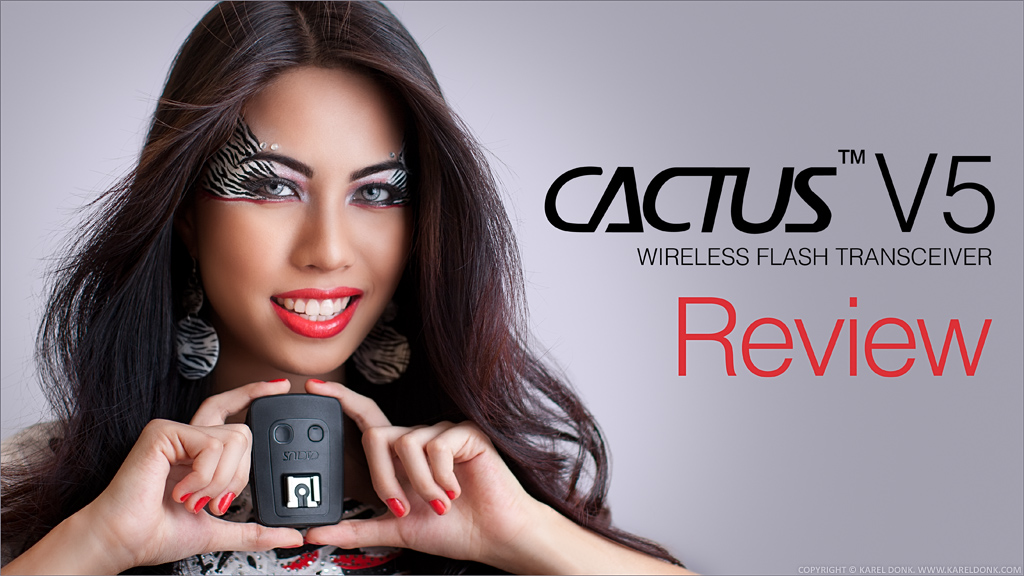
Review of the Cactus V5 Transceiver
In the second week of November 2010 I was contacted by Harvest One Limited as part of a small group of photographers around the world about testing a new version of their Cactus wireless flash triggers. At that time their latest model was the Cactus V4 Wireless Flash Trigger which I had been using for a few months already. So when the opportunity was presented to me to be able to have an early look at the next generation of these triggers I accepted it immediately. Harvest One would ship all participating photographers a couple of pre-production versions of the new units and the only requirement was that we would give suggestions for improvements and other feedback during the testing period and in the end write about our experiences with the new units on our websites and/or blogs.
As a user of the Cactus V4 triggers I have overall been very happy with the value I got for my money. The V4 triggers have proven to be very capable and reliable and I have done some serious work with them including using them during my photoshoot for the president of Suriname. There were some things that could have been better with the V4 system. For example, the battery compartment door could easily get detached and this was an issue many people complained about. Occasionally you could also get some reliability issues with flashes not firing when taking a picture, though this didn’t happen very often. In my post about the photoshoot for the president of Suriname, I mentioned how the Cactus V4 trigger was a lot more practical and reliable when in use than Canon’s wireless trigger (the ST-E2, which I also own), while also being a lot cheaper. And I still think this is the case. So the Cactus V4 already offered some good value for the money you’d spend on them. But with the new Cactus V5 transceiver the value you get for your money is taken to a much higher level.
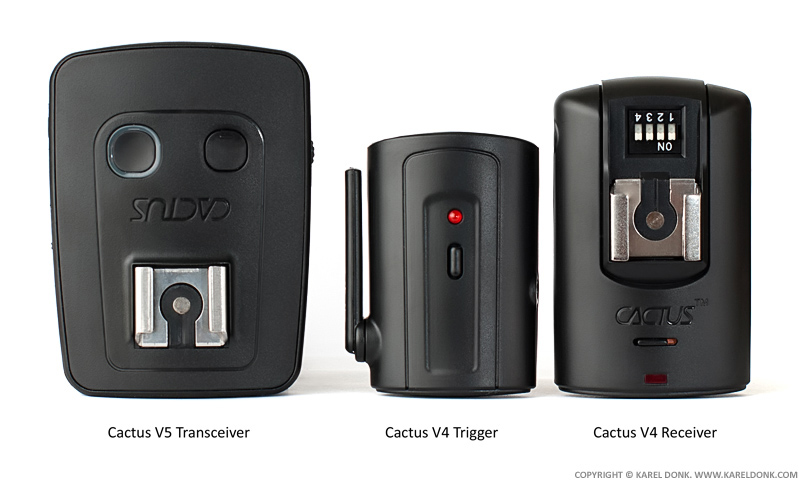
The Cactus V5 Transceiver compared to the Cactus V4 Trigger
Improvements
The Cactus V5 system represents a significant improvement over the older V4 system. Let’s look at some of the new features:
– New Transceiver Design
The Cactus V5 has a new transceiver design. This means that each V5 unit can function both as a trigger and a receiver (controlled through the Mode Switch on the unit). It is also much bigger compared to the V4 unit so you’ll have to keep this in mind when using it with other gear.
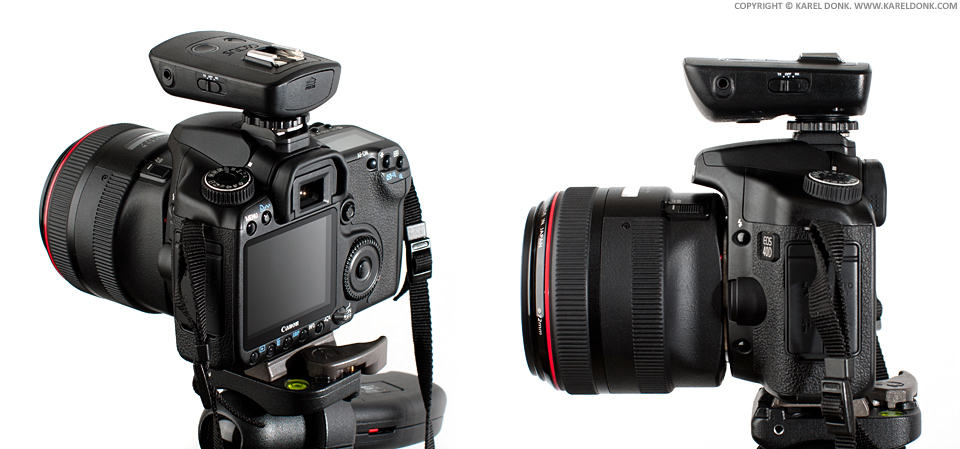
The Cactus V5 mounted as a trigger on the Canon EOS 40D
With the V4 system you had a dedicated trigger unit and a dedicated receiver unit. You’d then use a V4 trigger to trigger a number of V4 receivers. If the trigger unit became defective then you’d have to have a backup trigger unit to be able to continue to work. But with the V5 system any of the units can function as a trigger, so you can just take one of the receivers and use that as a trigger in such a case. This is one of the advantages of the transceiver design. You can always walk around with an extra V5 unit and that can be used both as a backup trigger and backup receiver. In comparison, with the V4 system I had to walk around with an extra V4 trigger unit and an extra V4 receiver unit.
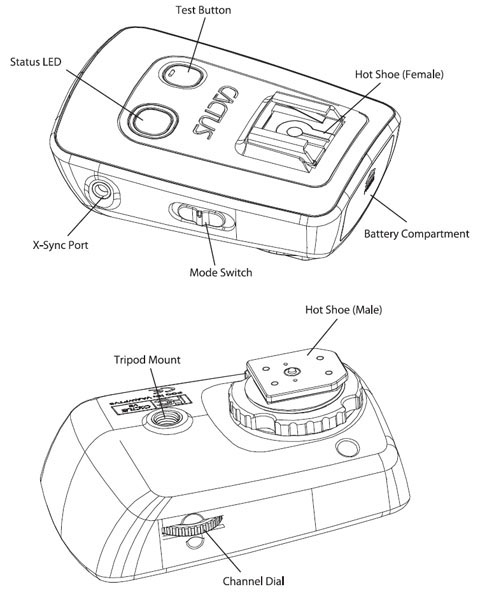
Cactus V5
The specifications are as follows:
– Working radio frequency: 2.4 Ghz.
– 16 selectable channels
– Sync speeds of up to 1/1000s supported
– Maximum effective distance of 100 meters
– Operating temperature of -20 °C to +50 °C
– Dimensions: 82mm (L) x 70mm (W) x 37mm (H)
– Weight: 58g
– Power input: 2 x AAA 1.5V batteries
– Flash voltage handling up to 300v
– Camera voltage handling up to 6v
– Better Reliability
The Cactus V5 transceiver is a lot more reliable than the V4 system. I have yet to experience reliability issues with these units. They’re practically 100% reliable within 50 meters. During tests, as long as my flashes were able to recycle fast enough, these units kept firing them every time.
– Frequency Self-Tune (FST)
The Cactus V5 transceiver has a unique new Frequency Self-Tune (FST) feature that automatically adjusts for frequency shifts in extreme weather conditions to increase reliability. According to Harvest One this feature will minimize no-fires in extreme conditions. I live in a tropical part of the world, but some of the other photographers in our testing group have tested the V5 in very cold weather conditions and they have proven to be practically 100% reliable. Check out the list of other reviews further down for more information on this.
– Improved Battery Compartment
The new battery compartment on the V5 is a big improvement compared to the V4 and according to Harvest One it is highly durable and has been tested to continue to function even after 3000 clicks. The door to the battery compartment on the Cactus V4 could detach all by itself if you merely gave it the wrong look. In comparison this new design on the V5 is just great.
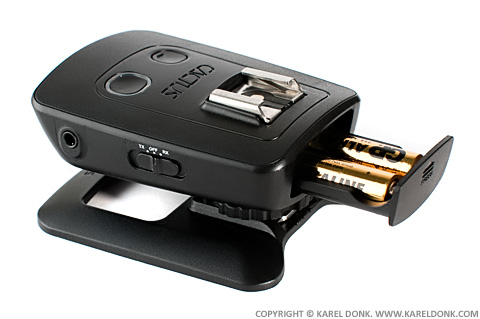
The Cactus V5 Battery Compartment
– Maximum Range of 100 Meters!
The Cactus V5 transceiver can work reliably over a maximum distance of 100 meters. Some testers have reported even greater distances, as far as 240 meters (with decreased reliability), where they were still able to use the V5 with some no-fires in between. At least one tester reported reliable results at 200 meters (check links to other reviews below). But it is important to note that Harvest One themselves only advertise a reliable working distance of 100 meters. How much further you can take this also depends on the environment that you’re working in.
– Multi-Channel Triggering
With the Cactus V5 transceiver you can have up to 4 groups of receivers each with their own channel (Channel 2 – 5) and with any number of receivers in each group. You can then control on the trigger which one of these groups you want to trigger when taking a picture. Channel 1 on the trigger fires all groups. If you want to trigger only a certain group of receivers, all you have to do is set the trigger to the group’s channel and only that group of flashes will fire.
– Camera Shutter Release Functionality
The Cactus V5 transceiver can also be used as a wireless shutter release. To be able to use this functionality you’ll have to buy a shutter release cable that is being sold separately by Harvest One. When using this functionality, half pressing the test button on the trigger activates the autofocus system of the camera and fully pressing the test button takes a picture. Using this feature you can reliably trigger your camera wirelessly from up to 100 meters away.
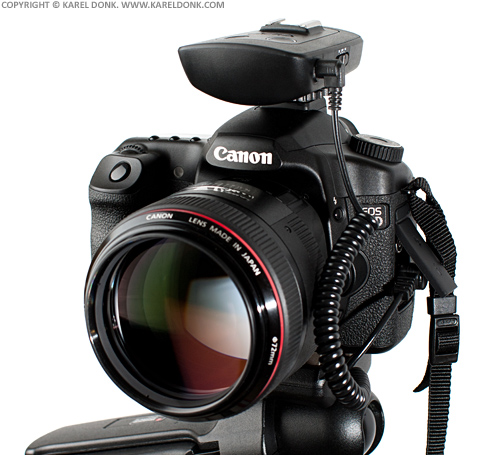
The Cactus V5 mounted on a Canon EOS 40D and being used as a wireless shutter release (shutter release cable is sold separately)
– Extra Hot Shoe
There is now an extra hot shoe on top of the V5 unit that functions as the trigger. This enables you to mount a flash on top of the trigger on your camera and use it as an on-axis fill light. TTL information will not be passed through to the flash mounted on top of the trigger so you’ll have to work in manual mode.
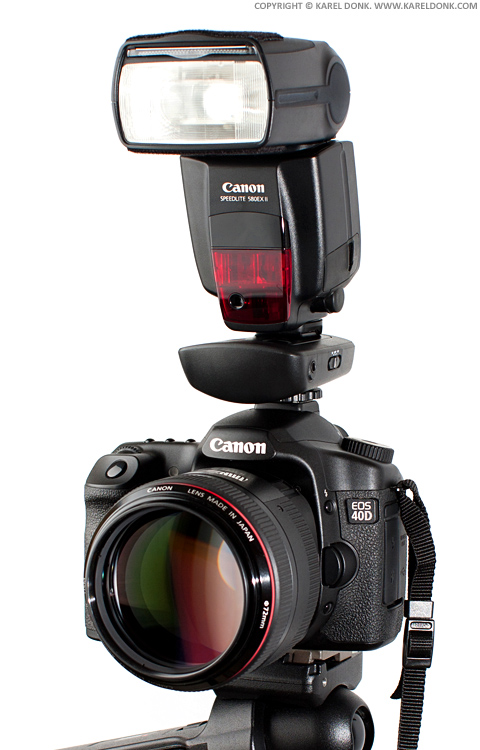
The Cactus V5 mounted on a Canon EOS 40D with a Canon 580 EX II Flash on top
– Improved Status Led
The status led on the V5 indicates when the receivers are being triggered by the shutter release on the camera (green light), when they are being tested by half-pressing the test button on the trigger (orange light) and when the batteries are low (blinking red light). The battery low indication is a very welcome new feature because on important shoots you can get an early warning if the batteries need to be replaced. According to Harvest One, after the low battery indicator flashes at room temperature, it’s possible to get an average of 7-8 hours of “standby” time until the batteries completely die out.
– Maximum Sync Speed of 1/1000s
The Cactus V5 supports a maximum sync speed of 1/1000s. I used the V5 on Canon EOS 40D bodies and was able to work at the maximum supported (by the camera) sync speed of 1/250s without banding issues. On some Nikon bodies for example you’ll be able to work at sync speeds up to 1/1000s.
– Better Flash Stands
The Cactus V5 transceivers come with a much better flash stand compared to the older V4 system. The flash stand can be used on the V5 unit itself or on the flash.
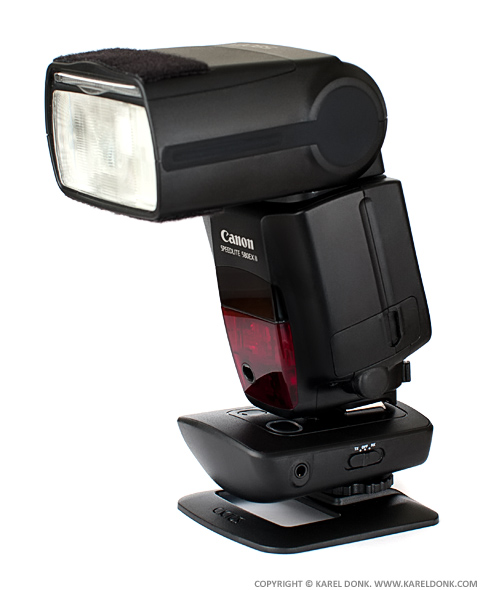
A Canon 580 EX II Flash mounted on the Cactus V5 Transceiver
No Support for TTL
The Cactus V5 does not support TTL. So if you plan on using these triggers, prepare to work in manual mode all the time. It also does not support TTL pass-through for the flash mounted on top of the V5 trigger on the camera. Depending on how you like to work, this may or may not be an issue for you. When using off-camera lighting I want to have precise control over my lights, so the fact that TTL is not supported is not a big deal for me personally. If TTL is important to you then you’ll have to look at the more expensive Radio Popper or Pocket Wizard.
Compatibility with the Cactus V4
As far as compatibility with the older V4 system goes, there’s good news and there’s bad news. The bad news is that you will not be able to trigger the V4 receivers with the V5 trigger, and you will not be able to trigger the V5 receivers with a V4 trigger. The V5 is not compatible with the V4 in that way. However, the good news is that if you already have invested in the V4 system, it won’t be useless if you want to get a couple of the V5 units. You can use the V4 system together with the V5 by mounting the V4 trigger on top of the V5 trigger on the camera as shown in the image below.
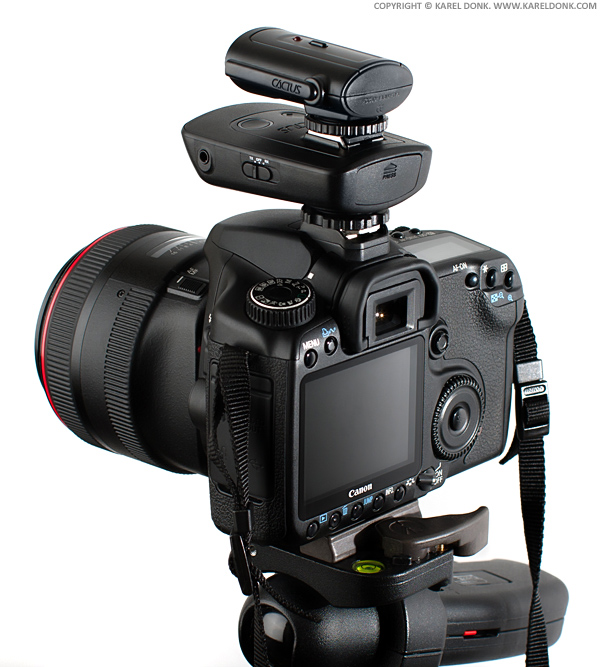
Using the Cactus V5 with the Cactus V4
This way you can trigger both V5 and V4 receivers when you take a picture. It is not an ideal way of working, but it does the job. There’s also the possibility of having a V5 receiver trigger the V4 trigger using the supplied sync cable, but then you’ll get banding at the maximum sync speed. So the best way to use the V5 and V4 together is by mounting the V4 trigger on top of the V5 trigger on the camera. I’ve actually used this setup during two test photoshoots that I have done (read about them below) and it worked very well. But you’ll have to keep in mind that using the V5 and the V4 together is not recommended and not supported by Harvest One, and any damages resulting from using these units this way will not be covered by the warranty.
Test Photoshoots
While testing the Cactus V5 I thought of doing some test photoshoots to see how it would perform if I were to use it for actual work. Based on my experiences during these test photoshoots I would know if the V5 would be worth upgrading to in the future.
I like macro photography so one of the first things I tried out was to see if I could use the V5 for off camera lighting during macro photography. I went out with a lightstand, a Canon 580 EX II flash on a V5 receiver and a shoot through umbrella and made shots of insects, flowers and other small objects. In most cases the flash was positioned to my left at about 45 degrees from the subject, about 50cm to 1 meter away. Sometimes I would stand at equal distance from the subject to the light and sometimes even slightly in front and to the side of the light. This is a scenario that wouldn’t work with the Canon wireless trigger, the ST-E2 since you’d always have to place your lights in front of the trigger within a specific range and distance. But with the Cactus V5, I just placed my light where I wanted and was free to walk around to try all kinds of angles on my subject. I had 100% reliability here. A couple of images I took during this outdoor macro session can be seen in the gallery below, all were taken with the Canon EF 180mm f/3.5 L Macro lens.
I also tried a portrait shoot to see how the Cactus V5 would do in a studio setting. I invited my friend Navin Poeran, a SEO specialist, to have some photos taken which he could later use on his blog and social networking websites. For this shoot I wanted to end up with a specific kind of tech-look, which was achieved in part with the lighting and in part with post processing. I used 4 Canon 580 EX II flashes, 2 of them triggered by Cactus V5 units and 2 of them triggered by Cactus V4 units. There was one background light, 2 lights (small shoot through umbrellas) on each side and slightly to the back of the subject and one light in front and slightly to the side in a 90cm x 90cm softbox. I wanted to experiment with shallow depth of field so I shot mainly at f/2 (Canon EF 50mm f/1.2 L lens), which meant that the power on the flashes was dialed down all the way to about 1/64th. The lights were placed close to the subject. Here I had 100% reliability for the V5 units and some no-fires for the V4 units. All shots were taken at 1/250s (max sync on the EOS 40D) and I had no banding issues.
And finally I did yet another studio shoot with a very talented painter and make-up artist named Carol Chen Poun Joe. You can find her and see some of her work on her facebook page. I wanted to do a photoshoot with extreme eye make-up and Carol was prepared to not only do the make-up but to also be the model for this photoshoot. This means that she had to do the make-up on herself. I told her what I wanted to do for the eye make-up and she came up with two very nice make-up styles all by herself: A zebra eye make-up look and a fantasy look. The fact that she also did this make-up on herself (especially the more complex looking zebra eye make-up) is a testament to her skills. You can see her doing her own make-up in the gallery below. Apart from being very talented she’s also very beautiful and can sometimes be mistaken for Megan Fox.

Carol Chen Poun Joe or Megan Fox?
Now if you’ll stop staring for a moment, I want to explain the lighting I used for this photoshoot. The lighting here was very similar to the previous photoshoot with Navin, but the difference here was that I placed the lights much further away from the model and used higher power settings. So it was 4 Canon 580 EX II flashes, 2 of them triggered by Cactus V5 units and 2 of them triggered by Cactus V4 units. There was one background light, 2 lights (small shoot through umbrellas) on each side and slightly to the back of the subject and one light in front in a 90cm x 90cm softbox. During the photoshoot I sometimes moved the softbox to the left or right of my position depending on the orientation of the model. Here I also experimented with some shallow depth of field shots using the Canon EF 50mm f/1.2 L lens. I also used the Canon EF 35mm f/1.4 L lens for some of the shots. During this photoshoot I had 100% reliability for the V5 units and some no-fires for the V4 units. All shots were taken at 1/250s (max sync on the EOS 40D) and I had no banding issues.
Gallery
Below is a gallery of pictures I made during my test photoshoots. Click on the “Full Screen” button in the lower-right corner to see larger images.
 Test Macro photoshoot — A bee on final approach, the sun was overpowered here by flash (1/2 power) and the background which would have been green bokeh went black
Test Macro photoshoot
A bee on final approach, the sun was overpowered here by flash (1/2 power) and the background which would have been green bokeh went black
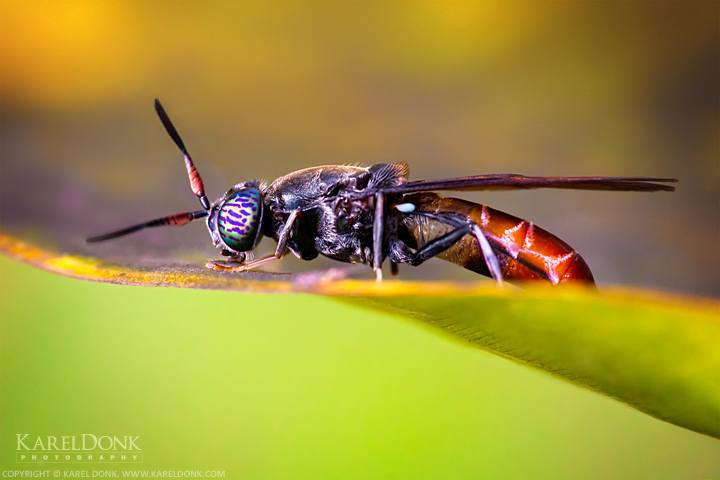
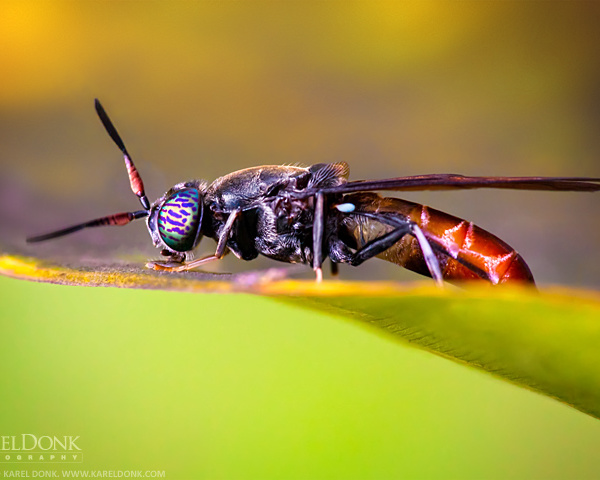 Test Macro photoshoot — Close-up of some kind of insect
Test Macro photoshoot
Close-up of some kind of insect
 Test Macro photoshoot — Close-up of a small spider
Test Macro photoshoot
Close-up of a small spider
 Test Macro photoshoot — Close-up of a small fly
Test Macro photoshoot
Close-up of a small fly
 Test Macro photoshoot — Close-up of a small spider (almost looks like a lolspider)
Test Macro photoshoot
Close-up of a small spider (almost looks like a lolspider)
 Test Macro photoshoot — Close-up of a small fly
Test Macro photoshoot
Close-up of a small fly
 Test Macro photoshoot — Close-up of soap bubbles, 2 gelled flashes used for this shot
Test Macro photoshoot
Close-up of soap bubbles, 2 gelled flashes used for this shot
 Test photoshoot with Carol Chen Poun Joe — First session: Zebra eye make-up
Test photoshoot with Carol Chen Poun Joe
First session: Zebra eye make-up
 Test photoshoot with Carol Chen Poun Joe — First session: Zebra eye make-up
Test photoshoot with Carol Chen Poun Joe
First session: Zebra eye make-up
 Test photoshoot with Carol Chen Poun Joe — First session: Zebra eye make-up
Test photoshoot with Carol Chen Poun Joe
First session: Zebra eye make-up
 Test photoshoot with Carol Chen Poun Joe — First session: Zebra eye make-up
Test photoshoot with Carol Chen Poun Joe
First session: Zebra eye make-up
 Test photoshoot with Carol Chen Poun Joe — First session: Zebra eye make-up
Test photoshoot with Carol Chen Poun Joe
First session: Zebra eye make-up
 Test photoshoot with Carol Chen Poun Joe — First session: Zebra eye make-up
Test photoshoot with Carol Chen Poun Joe
First session: Zebra eye make-up
 Test photoshoot with Carol Chen Poun Joe — First session: Zebra eye make-up
Test photoshoot with Carol Chen Poun Joe
First session: Zebra eye make-up
 Test photoshoot with Carol Chen Poun Joe — First session: Zebra eye make-up
Test photoshoot with Carol Chen Poun Joe
First session: Zebra eye make-up
 Test photoshoot with Carol Chen Poun Joe — Second session: Fantasy eye make-up
Test photoshoot with Carol Chen Poun Joe
Second session: Fantasy eye make-up
 Test photoshoot with Carol Chen Poun Joe — Second session: Fantasy eye make-up
Test photoshoot with Carol Chen Poun Joe
Second session: Fantasy eye make-up
 Test photoshoot with Carol Chen Poun Joe — Second session: Fantasy eye make-up
Test photoshoot with Carol Chen Poun Joe
Second session: Fantasy eye make-up
 Test photoshoot with Carol Chen Poun Joe — Second session: Fantasy eye make-up
Test photoshoot with Carol Chen Poun Joe
Second session: Fantasy eye make-up
 Test photoshoot with Carol Chen Poun Joe — Second session: Fantasy eye make-up
Test photoshoot with Carol Chen Poun Joe
Second session: Fantasy eye make-up
 Test photoshoot with Carol Chen Poun Joe — Second session: Fantasy eye make-up
Test photoshoot with Carol Chen Poun Joe
Second session: Fantasy eye make-up
 Test photoshoot with Carol Chen Poun Joe — Second session: Fantasy eye make-up
Test photoshoot with Carol Chen Poun Joe
Second session: Fantasy eye make-up
 Test photoshoot with Carol Chen Poun Joe — Second session: Fantasy eye make-up
Test photoshoot with Carol Chen Poun Joe
Second session: Fantasy eye make-up
 Test photoshoot with Carol Chen Poun Joe — Behind the scenes: Carol doing her make-up for the first session
Test photoshoot with Carol Chen Poun Joe
Behind the scenes: Carol doing her make-up for the first session
 Test photoshoot with Carol Chen Poun Joe — Behind the scenes: Carol doing her make-up for the first session
Test photoshoot with Carol Chen Poun Joe
Behind the scenes: Carol doing her make-up for the first session
 Test photoshoot with Carol Chen Poun Joe — Behind the scenes: Carol doing her make-up for the first session
Test photoshoot with Carol Chen Poun Joe
Behind the scenes: Carol doing her make-up for the first session
 Test photoshoot with Carol Chen Poun Joe — Behind the scenes: Carol doing her make-up for the first session
Test photoshoot with Carol Chen Poun Joe
Behind the scenes: Carol doing her make-up for the first session
 Test photoshoot with Carol Chen Poun Joe — Behind the scenes: Carol doing her make-up for the first session
Test photoshoot with Carol Chen Poun Joe
Behind the scenes: Carol doing her make-up for the first session
 Test photoshoot with Carol Chen Poun Joe — Behind the scenes: Carol doing her make-up for the first session
Test photoshoot with Carol Chen Poun Joe
Behind the scenes: Carol doing her make-up for the first session
 Test photoshoot with Carol Chen Poun Joe — Behind the scenes: Carol doing her make-up for the first session
Test photoshoot with Carol Chen Poun Joe
Behind the scenes: Carol doing her make-up for the first session
 Test photoshoot with Carol Chen Poun Joe — Behind the scenes: Carol doing her make-up for the first session
Test photoshoot with Carol Chen Poun Joe
Behind the scenes: Carol doing her make-up for the first session






























Conclusion
Based on my experiences with testing the Cactus V5 transceiver, I can tell you that I am going to be buying them as soon as they are available and will be replacing my Cactus V4 system entirely. They are a lot better than the Cactus V4 and certainly a lot more reliable. And if you look at the costs (two V5 units for a mere $60), I think it’s an incredible deal. Radio Popper and Pocket Wizard have some serious competition now with their (lots) more expensive products. For the price of a single Pocket Wizard FlexTT5 unit ($229) you can get 7 Cactus V5 units. And reliability is just as good and perhaps even better if you look at the comparison another reviewer made (check reviews below). The only thing the Cactus V5 doesn’t have that’s really worth having for some users is the TTL functionality.
Another thing is that the Cactus V4 already put the Canon ST-E2 to shame and now the Cactus V5 is doing it all over again. Canon is still trying to sell us a fucking piece of plastic junk for almost $250 with a maximum working range of 15 meters (10 meters out-doors) that needs line of sight to be able to work well. For that price you can get 8 Cactus V5 units that work a lot better and give you a lot more freedom. I keep wondering when Canon is finally going to bring us some fucking innovation after all the mediocrity they’ve been releasing recently. If a small company like Harvest One Limited with limited resources is able to design such a relatively kick-ass product in about 18 months, why can’t the big and mighty Canon do it? Okay let me stop now, I’m beginning to sound like someone else.
Availability
The Cactus V5 will be available for sale on Gadget Infinity starting on Monday, January 24, 2011 at 00:00 (PST) and first shipments are expected to begin on January 26th. It will be available in two packages:
- Wireless Flash Transceiver V5 Duo – Price: $59,95
A box containing two Cactus V5 transceiver units. - Wireless Flash Transceiver V5 Single – Price: $34,95
A box containing a single Cactus V5 transceiver unit.
Other Reviews
There’s much more to say about the new Cactus V5 system and many more tests were done by others. Below is a list of reviews done by other photographers in our test group where you can find additional information:
- Review by Brian Hursey
General information, maximum range reliability tests up to about 180 meters and videos. - Review by Nicolas B Photo (French)
General information, maximum range reliability tests in cold weather, wireless shutter release information. - Review by Eric Duminil
General information, maximum range reliability tests comparing the V5 with the Pocket Wizard Plus II. According to this test the V5 is a lot more reliable than the Pocket Wizard Plus II, even as far as 240 meters. Very impressive. - Review on Steelevisions
General information. - Review on Pentaxforums
General information, maximum range reliability tests, comparisons with other wireless flash triggers. - Review on Rudy’s Rants
General information, maximum range reliability tests up to 200 meters in cold weather, maximum frame rate tests with an impressive 39 fps result! - Review on Lighting Rumours
General information, max sync speed tests on Nikon D40 (1/1000s) and D700 and comparison with other wireless flash triggers on the market.
Updates
Update January 25, 2011: There appears to be an extremely high demand for the new Cactus V5 transceivers and initial stock has been completely sold out within 15 hours. Gadget Infinity seems to be caught by surprise with the high demand, but in my opinion they had to have seen this coming because the V5 is a killer product. So if you go on their website and find the Cactus V5 out of stock, try again the next day. Here’s part of a message from Gadget Infinity:
As many of you are aware, the Cactus Wireless Flash Transceiver V5 (V5) was released yesterday, and after less than 15 hours, the V5 Duo was all sold out while a limited number of V5 Single is still available.
We are extremely excited about the high demand for V5. However, given that each V5 unit is inspected one-by-one to ensure quality and reliability, our supply level is insufficient to meet this unexpected high demand. In light of this, we are making efforts to increase our production supply, and hope to achieve this within the shortest timeframe possible.
For the time being, we will make a limited supply of V5 (Duo and Single) available on Gadget Infinity every Monday, Wednesday, and Friday 00:00 PST.
Please accept our sincere apologies if this supply shortage has caused any inconvenience for you. Lastly, we’d like to thank you for your support of Cactus Image and Gadget Infinity, and we look forward to serving you soon.

Comments
There are 34 responses. Follow any responses to this post through its comments RSS feed. You can leave a response, or trackback from your own site.